Chongqing is a city like no other—nestled among steep hills, crisscrossed by rivers, and alive with vibrant street life. From the dazzling neon-lit Hongyadong (洪崖洞 Hóngyádòng) to the historic charm of Ciqikou Ancient Town (磁器口 Cíqìkǒu) , this mountain city offers a perfect mix of tradition and modernity. Ride the train through the building at Liziba Station (李子坝站 Lǐzǐbà Zhàn) , sip tea in a nostalgic old teahouse, or take in panoramic city views from the Yangtze River Cableway (长江索道 Chángjiāng Suǒdào) —each attraction reveals a unique side of Chongqing.
Whether you’re exploring on a 2-day itinerary or hopping on the Chongqing Tourist Sightseeing Bus , these Chongqing attractions promise unforgettable experiences and the true taste of China’s “8D city.”
Hongyadong(洪崖洞 Hóngyá Dòng):A Real-Life Spirited Away Adventure
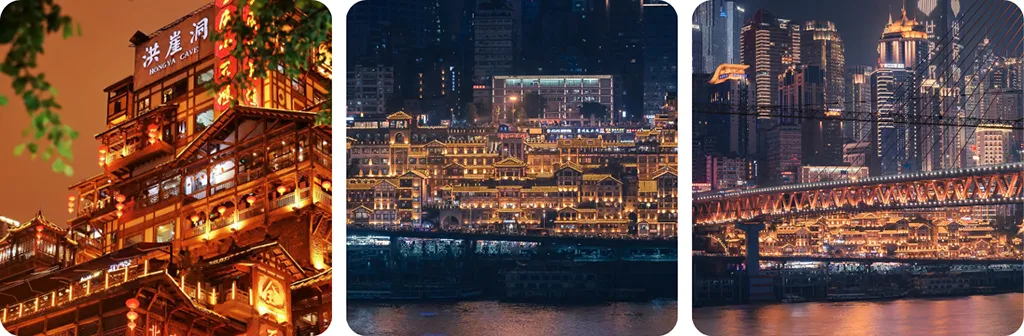
Located along the lower section of Cangbai Road (Cāngbǎi Lù) , Hongyadong has a history of more than 2,000 years. With cliffs behind it and rivers in front, this landmark was built on a 75-meter-high rock wall, creating the most iconic diaojiaolou (吊脚楼, stilted Bayu-style houses) in Chongqing. The architecture blends Ba-Yu folk traditions , mountain-style residences, and old port culture.
When night falls, the entire structure glows with warm lights, looking strikingly similar to the bathhouse in Spirited Away.
When night falls, the entire structure glows with warm lights, looking strikingly similar to the bathhouse in Spirited Away.
Hongyadong has 11 floors in total:
-
4th–8th floors : Food streets
-
9th–10th floors : Cafés and bars
-
Other floors: Small souvenir shops and local vendors
Best Photo Spots
1. Full Panorama Shot
From the midway point of Qiansimen Bridge (Qiānsìmén Dàqiáo) , you can capture the river and the entire Hongyadong complex in one frame.
From the midway point of Qiansimen Bridge (Qiānsìmén Dàqiáo) , you can capture the river and the entire Hongyadong complex in one frame.
2. Spirited Away Angle
Stand on Jiabin Road (Jiābīn Lù) across the riverside lane—this spot gives you that perfect Spirited Away look.
Stand on Jiabin Road (Jiābīn Lù) across the riverside lane—this spot gives you that perfect Spirited Away look.
3. Instagram Shot
Start at the ground-level road on the first floor, walk toward the bottom of Qiansimen Bridge, and shoot upward with a 16–35mm wide-angle lens for a dramatic, magazine-worthy photo.
Start at the ground-level road on the first floor, walk toward the bottom of Qiansimen Bridge, and shoot upward with a 16–35mm wide-angle lens for a dramatic, magazine-worthy photo.
How to Get There
Metro
-
Line 2 → Linjiangmen Station (Línjiāngmén Zhàn)
-
Line 1 or Line 6 → Xiaoshizi Station (Xiǎoshízì Zhàn)
Bus
Get off at:
Get off at:
-
“Hongyadong” stop
-
“Hongyadong Tourist Wharf” stop
-
“Xiaoshizi” stop
Useful Info
-
Lighting hours : Around 18:00–23:00
-
Best viewing time : Around 21:00
Ciqikou (磁器口 Cíqìkǒu): Chongqing’s Most Lively Ancient Town
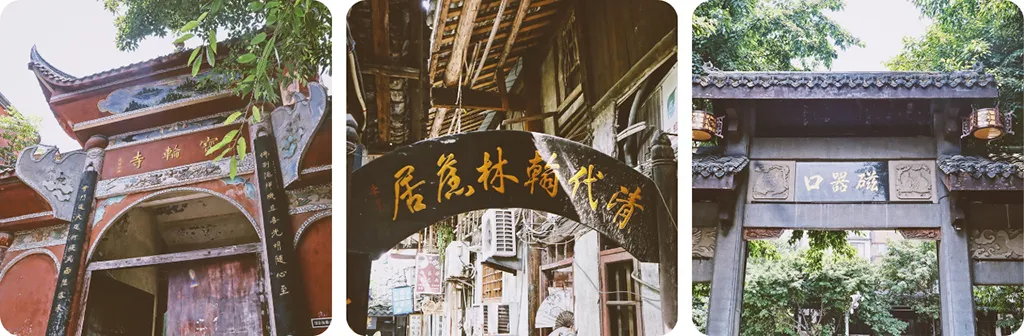
Located along the banks of the Jialing River (Jiālíngjiāng) , Ciqikou Ancient Town dates back to the Song Dynasty. With its unique landscape of “one river, two streams, three mountains, and four streets,” it naturally formed into a thriving port and became a major land–water transportation hub along the Jialing River.
A single stone-paved street has carried the spirit of Ciqikou for over a thousand years. Often called “Mini Chongqing ,” the ancient town is considered a living symbol of Chongqing’s old urban charm. Here, you can easily spot traditional crafts passed down for generations—like old-style oil pressing, silk reeling, sugar making, dough figurines, Sichuan opera performances—as well as countless teahouses and street snacks.
Top Things to See
1. Hanlin Courtyard (翰林院)
Originally known as Lishi Academy, it became an academic center run by the Sun family in the late Qing Dynasty and was once a dream destination for aspiring scholars.
2. Bayu Folk Residence Museum (巴渝民居馆)
This small museum showcases the essence of traditional Bayu architecture. Walk through its wooden beams, stone walls, enclosed courtyards, and peaceful spaces to experience a nostalgic journey into the past.
3. Baolun Temple (宝轮寺)
According to history, Emperor Jianwen of the Ming Dynasty once took refuge here, making it a spot full of stories.
4. Shenshuijing (深水井)
One of the best-preserved Ming Dynasty relics in Ciqikou.
5. Baoshan Palace (宝善宫)
Once converted into Jialing Primary School during the Republic of China era—Nobel Prize–winning physicist Samuel C. C. Ting (丁肇中 Dīng Zhàozhōng) studied here for three years.
Inside Baoshan Palace, you can visit a ceramics museum to learn about the entire pottery-making process, as well as a memorial room dedicated to Professor Ting.
Inside Baoshan Palace, you can visit a ceramics museum to learn about the entire pottery-making process, as well as a memorial room dedicated to Professor Ting.
Read Next: Planning where to stay in Chongqing? Check our Best Chongqing Accommodation Guide for top areas and hotel picks for every budget.
Best Photo Spot
Baolun Temple is the hidden gem of Ciqikou. The temple itself, along with the old streets surrounding it, looks beautiful both day and night. When the evening lights come on, Baolun Temple glows with a warm charm.
In autumn, the golden ginkgo trees inside the temple make it an even more photogenic spot.
In autumn, the golden ginkgo trees inside the temple make it an even more photogenic spot.
How to Get There
Take the metro or bus to Ciqikou Station (Cíqìkǒu Zhàn) and walk straight into the ancient town.
Travel Tip: Ciqikou gets extremely crowded, especially on weekends and public holidays. For a more relaxed visit, go in the early morning—preferably before 8 AM.
Useful Information
-
Tickets : Free
-
Opening hours : Open all day
Scenic Area Entrances (4 total):
-
Huangjueping Gate (黄桷坪大门) – Entrance only ; ideal for visitors arriving by car or bus.
-
Jinrong Gate (金蓉门) – Entry & exit; most convenient for metro travelers.
-
Qingshuimen Square / Shaci Ancient Road (清水门广场沙磁古道) – Entry & exit; good for self-driving travelers.
-
Caijiawan Gate (蔡家湾, opposite No. 69 Middle School) – Exit only.
Jiefangbei(解放碑 Jiěfàng Bēi):Chongqing’s Oldest Commercial District
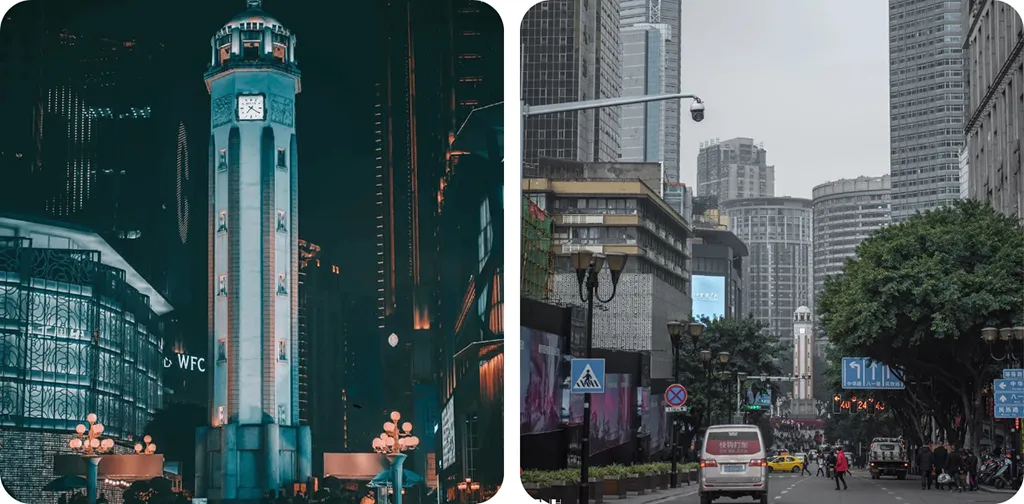
A trip to Chongqing isn’t complete without a stroll through Jiefangbei —skipping it would be like visiting the city and not trying hotpot. As the earliest commercial center in Chongqing’s main urban area, Jiefangbei is a living witness to the victory of the War of Resistance and the liberation of Chongqing. It is also one of the city’s most iconic landmarks.
Towering skyscrapers, luxury malls, and stylish locals walking the streets all come together to show off the dazzling pulse of this modern metropolis.
How to Explore Jiefangbei
Classic Historical Route
-
Monument to the Victory of the War of Resistance(抗战胜利纪念功碑)
-
Luohan Temple(罗汉寺)
-
Bayi Food Street(八一好吃街)
-
Jiaochangkou Night Market(较场口夜市)
Art Route
-
Guotai Arts Center(国泰艺术中心)
-
Chongqing Art Museum(重庆美术馆)
-
Chiba Art Museum(千叶美术馆)
-
Mountain City Trail(山城步道)
Historic Architecture Route
-
Former Sino-British Liaison Office(中英联络处旧址)
-
Former Xinhua Daily Office(新华日报营业部旧址)
-
Tongyuanmen Gate(通远门)
-
St. Joseph’s Cathedral(天主教若瑟堂)
-
Provisional Government of Korea Site(大韩民国临时政府旧址)
-
Daijia Lane(戴家巷)
Shopping Route
-
Metropolis Plaza(大都会广场)
-
Chongqing Times Square(重庆时代广场)
-
Sun Moon Light Center(Sun Moon Light Center 日月光中心广场)
-
Chongqing Department Store(重庆百货大楼)
-
Yingli International Shopping Center(英利国际购物中心)
-
Raffles City Chongqing(来福士购物中心)
Ferry Route
Ride the nostalgic Two Rivers Ferry(两江小渡).
Ferry Tips:
-
Boarding points: Hongyadong Tourist Wharf / Danzishi Wharf
-
Price: ¥15 (one way)
-
Ticket: WeChat public account “重庆交运两江游”
-
Ride duration: ~15 minutes
Best Photo Spots
1. Sci-Fi Skywalk Shot
Head to Daronhui Mall, 13F (大融汇 13F). The giant spherical structure looks like something straight out of a futuristic sci-fi movie.
2. Infinity Pool Skyline Shot
At the Westin Chongqing Liberation Square , the 54th-floor glass-viewing pool offers breathtaking skyline photos—especially at sunset with a floating afternoon tea set.
Note: This pool is only open from June to August.
Note: This pool is only open from June to August.
How to Get There
Metro : Line 1 or 2 → Linjiangmen Station (临江门站) , Exit B
Bus : Get off at “解放碑” stop
Bus : Get off at “解放碑” stop
Yangtze River Cableway(长江索道 Chángjiāng Suǒdào):A Bird’s-Eye View of Chongqing
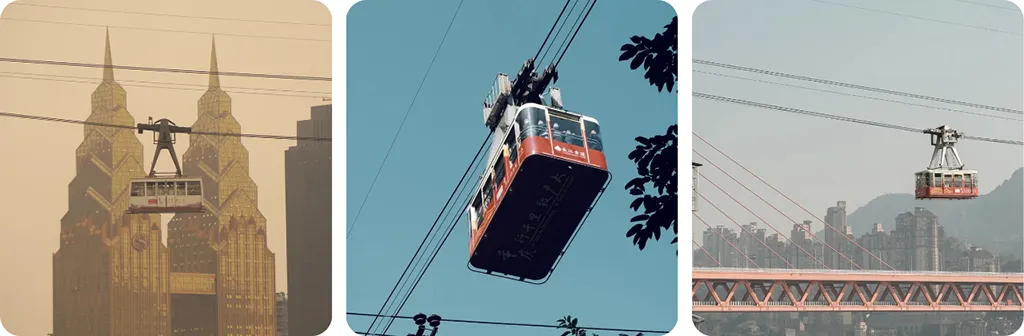
In December 1980, Chongqing began building China’s very first urban cableway—the Jialing River Cableway. Five years later, the country’s second cableway, the Yangtze River Cableway , officially opened.
Many films have been shot here, including Crazy Stone , The Door , Zhou Yu’s Train , and Chongqing Blues.
Many films have been shot here, including Crazy Stone , The Door , Zhou Yu’s Train , and Chongqing Blues.
Best Photo Spots
1. North Station Angle
From the ticket office at Xinhua Road North Station(新华路·索道北站) , walk down the small path on the right. At the stairway corner, look up—you’ll capture the cableway gliding right above your head.
2. Nanbin Road Riverside Angle
From the riverside of Nanbin Road (南滨路) , you can photograph the cableway passing by Dongshuimen Bridge and weaving between the twin skyscrapers.
Practical Tips
-
Ticket Price :
-
¥30 one-way
-
¥50 round trip
-
IC card users get discounted one-way fares
-
-
Operating Hours :
-
Peak season (Mar 1–Oct 31): 07:30–22:30
-
Off season (Nov 1–Feb 28): 07:30–21:30
-
Public holidays: Until 22:30
-
-
Frequency & Capacity:
-
One departure every ~6 minutes
-
Each cabin holds up to 50 passengers
-
Entrance Guide
-
North Entrance(北入口)
-
Pros : Close to Jiefangbei, Hongyadong, and easier transportation
-
Cons : Much longer lines compared to the south entrance
-
-
South Entrance(南入口)
-
Pros : Shorter queues
-
Cons : Less convenient transportation and slightly harder to locate
-
How to Get There
The cableway has two stations :
-
Xinhua Road North Station(新华路·索道北站)
-
Shangxin Street South Station(上新街·索道南站)
By Metro:
-
Line 6 → Xiaoshizi Station (小什字站) → Exit 5B → Walk to Xinhua Road North Station
-
Loop Line → Shangxin Street Station (上新街站) → Exit 2 → Walk to Shangxin Street South Station
Tickets: Through the official WeChat account “重庆索道公司”.
Jiaotong Teahouse(交通茶馆 Jiāotōng Chágǔan):A Classic Old Teahouse Steeped in Local Life
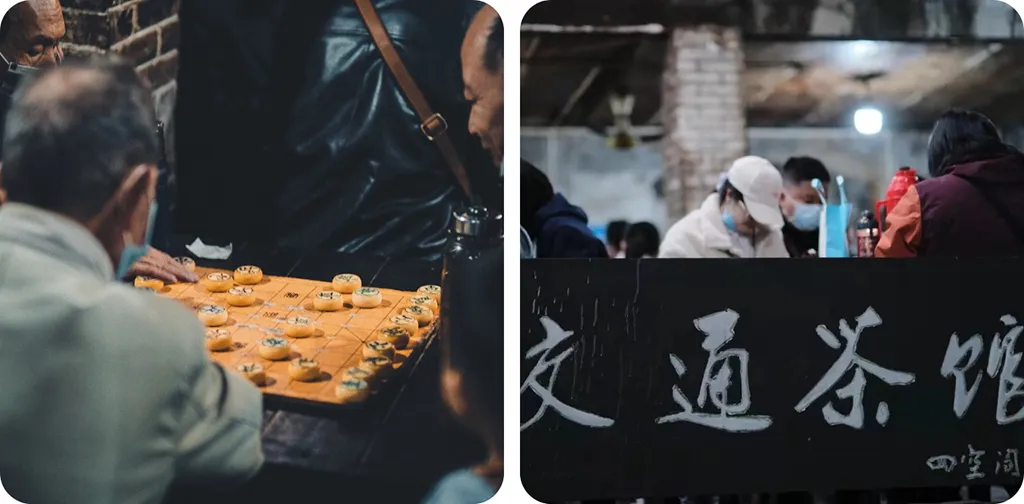
The famous Jiaotong Teahouse , located in Huangjueping(黄桷坪 Huángjuépíng) , is the only teahouse in Chongqing that still preserves the authentic 1980s vibe.
Before 1987, the building was just a simple canteen. Later, due to growing social needs, it was converted into a teahouse. Because it belonged to the Transportation Bureau, it naturally got its name—“Jiaotong” , meaning “transportation.”
Before 1987, the building was just a simple canteen. Later, due to growing social needs, it was converted into a teahouse. Because it belonged to the Transportation Bureau, it naturally got its name—“Jiaotong” , meaning “transportation.”
Walking inside today feels like stepping back decades: the worn wooden benches polished black with age, the clattering of mahjong tiles and chess pieces, and the smoky, nostalgic atmosphere all tell stories of old Chongqing.
How to Enjoy the Teahouse
Inside, you can sip tea, chat, play chess, card games, or mahjong.
If you're only here for photos, you’ll still need to make a purchase.
If you're only here for photos, you’ll still need to make a purchase.
Right outside, turn right and you’ll find Huangjueping Graffiti Street , a lively artistic enclave full of bold, “wild-growth” murals.
Local Tip:
Many elderly regulars love ordering noodles from the nearby Laomian Noodle Shop(老面馆) , which has been operating since 1992. The Dao Xiao Mian(刀削面) and Chongqing Xiao Mian(重庆小面) are especially popular. The noodle shop even has a small window connecting directly to the teahouse—you can order and enjoy your noodles inside.
Many elderly regulars love ordering noodles from the nearby Laomian Noodle Shop(老面馆) , which has been operating since 1992. The Dao Xiao Mian(刀削面) and Chongqing Xiao Mian(重庆小面) are especially popular. The noodle shop even has a small window connecting directly to the teahouse—you can order and enjoy your noodles inside.
Best Photo Tips
-
Outfits: Qipao or retro-style suits
-
Props: Chinese folding fans, round sunglasses
-
Best Spot: The table directly facing the black signboard is the prime shooting location—arrive early to claim it!
How to Get There
Take a bus and get off at “Huangjueping Zhengjie(黄角坪正街)” station.
Extra Tip:
Huangjueping Graffiti Art Street completed a major upgrade in late 2021, featuring more murals by well-known artists. It’s an excellent spot for vibrant, artistic photos.
Huangjueping Graffiti Art Street completed a major upgrade in late 2021, featuring more murals by well-known artists. It’s an excellent spot for vibrant, artistic photos.
Useful Info
-
Hours: 07:00–19:00
-
Prices: Tea ¥10, sunflower seeds ¥10, mahjong ¥20
E’ling Second Factory(鹅岭二厂 Élíng Èr Chǎng):From Printing Plant to Creative Hub
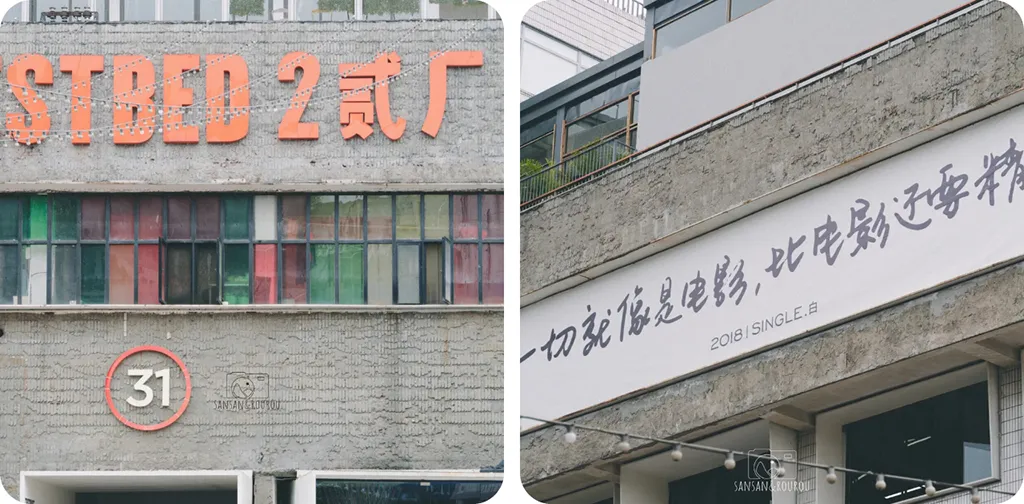
Originally, this site was a Central Bank Printing Machine Factory during the Republic of China era. It later became Chongqing Printing Factory No. 2 (印制贰厂 Yìnzhì Èr Chǎng) , responsible for color printing in Chongqing during the 1950s–70s. After a series of renovations, TESTBED2 Èr Chǎng Creative Park has transformed into a hotspot for young creatives and was also a filming location for the movie “I Belonged to You” (从你的全世界路过).
Best Photo Spots
High-Angle Shots
-
CITYRADIO Rooftop – Original rooftop from I Belonged to You , located at H Building, 6F entrance.
-
SKYLINE THAI – Infinity pool with city skyline view, also at H Building, 6F (inside the rooftop pool restaurant).
-
Xiao Rizi Rooftop – 270° panoramic view of the Two Rivers nightscape, at Building 31, 5F.
Vintage Shots
-
Èr Chǎng Warehouse Doors (贰厂仓门) – Popular check-in wall between Building 2 & 4, former Republic-era printing site. Seats nearby for portrait shots, located at Building 9, G Floor.
-
Tongling Alley (通灵巷) – Two photo points: Route 318 bus sign and a graffiti wall.
Installation Art Shots
-
Computer Installation Wall – Cool cyberpunk backdrop, at Building 1, B1 (sunken plaza).
-
Light Installation Tire Wall – In the small plaza.
-
Mirror Alley (镜遇小巷) – Filled with mirrors, located between Building 2 & 4.
How to Get There
-
Metro : Take the metro to E’ling Station(鹅岭站) , then walk ~10 minutes.
-
Bus : Get off at Yìnzhì Èr Chǎng Station(印制贰厂站).
-
Shuttle Bus : Runs daily 10:00–20:00 from the park plaza to Fotu Pass Station (Metro Line 2, Exit A) , stopping at Chongqing Emergency Medical Center , Lizi Ba Station (Line 2, Exit B) , and Li Zi Ba Liangshan Chicken Park Store. Fare: ¥5.
Huguang Guild Hall(湖广会馆 Húguǎng Huìguǎn):A Poetic Retreat Amid the Bustle
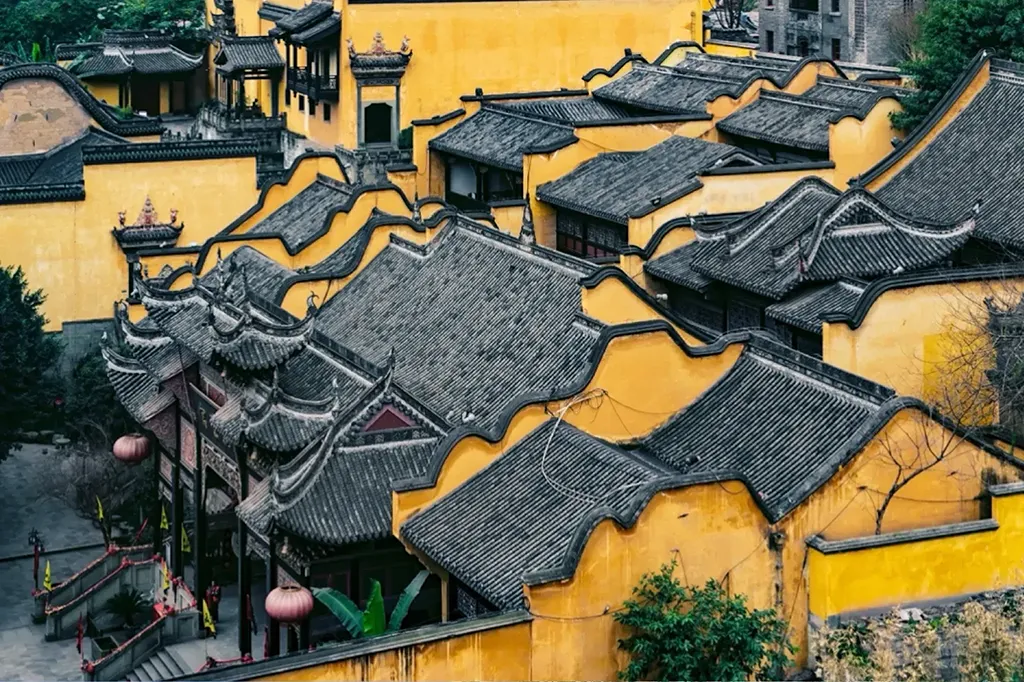
Built during the Kangxi reign over 300 years ago, the Huguang Guild Hall is a serene, poetic oasis in the heart of Chongqing’s bustling Yuzhong Peninsula. The complex features intricately carved beams and painted panels, representing southern Chinese architectural art from the Ming and Qing dynasties.
Most of the buildings follow the traditional siheyuan (courtyard) layout , offering high architectural value. The bright yellow facades, layered in depth, evoke the feeling of a Jiangnan-style garden when viewed from afar.
Most of the buildings follow the traditional siheyuan (courtyard) layout , offering high architectural value. The bright yellow facades, layered in depth, evoke the feeling of a Jiangnan-style garden when viewed from afar.
Top Things to See
1. Yuwang Palace (禹王宫)
Built along the slope, the palace houses a 5-meter tall bronze statue of Yu the Great , weighing 2 tons. The statue exudes majesty, reflecting the essence of Qing dynasty architecture.
2. Immigration Museum (移民博物馆)
China’s first immigration-themed museum, displaying hundreds of artifacts from the migration era. Learn about the “Huguang fills Sichuan” (湖广填四川) migration routes and legendary stories.
Navigation Tip: Look for Huguang Tiansichuan Immigration Museum.
Navigation Tip: Look for Huguang Tiansichuan Immigration Museum.
3. Guangdong Guild Hall (广东公所会馆)
The largest theater stage in the guild hall features a wooden Xieshan-style roof with pale green and yellow glazed tiles. The surrounding carvings depict classic Chinese operas like Journey to the West and Romance of the Western Chamber in vivid detail.
4. Qi’an Guild Hall (齐安公所)
Built by immigrants from Huangzhou, Hubei during the Qing Dynasty, this hall is the best-preserved building in the Huguang complex. The exquisite wood carvings around the stage, especially the “Apricot Blossom Village (杏花村 Xìnghuā Cūn)” , are a must-see.
Best Photo Spot
Exit the hall, walk straight to Gangyu Building (港渝大厦) , take the elevator to the 8th floor, then head toward Dongshuimen Bridge (东水门大桥). From the bridge, you can capture a stunning panorama of the Huguang Guild Hall.
How to Get There
-
Metro: Line 1 or 2 → Xiaoshizi Station (小什字站), Exit 4B
-
Bus: Get off at Huguang Guild Hall (湖广会馆) or Daomenkou (道门口) stop
Useful Info
-
Opening Hours: 09:00–16:00 (Closes at 17:00)
-
Tickets: ¥30 (Cultural performance: ¥58)
Liziba Station(李子坝站 Lǐzǐbà Zhàn):The Iconic “Train Through the Building”
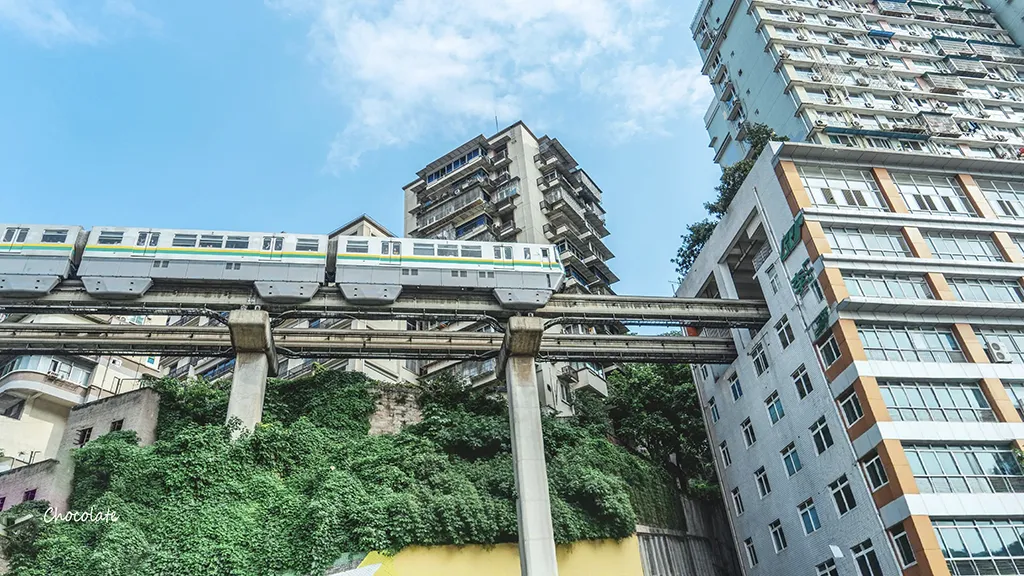
As one of Chongqing’s most famous social media spots, a single photo of a train passing through a building at Liziba Station once dominated platforms across China.
The station is located at the intersection of Jialingxin Road (嘉陵新路) and Guihuayuan Road (桂花园路) in Yuzhong District , bordered by the Jialing River (嘉陵江) to the north. Its platform spans the 6th to 8th floors of a 19-story building , making it a one-of-a-kind urban marvel and a trendy Chengdu–Chongqing landmark.
The station is located at the intersection of Jialingxin Road (嘉陵新路) and Guihuayuan Road (桂花园路) in Yuzhong District , bordered by the Jialing River (嘉陵江) to the north. Its platform spans the 6th to 8th floors of a 19-story building , making it a one-of-a-kind urban marvel and a trendy Chengdu–Chongqing landmark.
How to Explore
Start from Niujiaotuo (牛角沱) and take Line 2 to Liziba to experience the 132-meter-long ride through the building.
After exiting, descend one floor to visit the Bayu Historical Museum (巴渝旧闻馆) , where exhibits showcase major events in Chongqing’s opening-up over the past 60 years.
After exiting, descend one floor to visit the Bayu Historical Museum (巴渝旧闻馆) , where exhibits showcase major events in Chongqing’s opening-up over the past 60 years.
Guided Times: 09:30 / 11:30 / 13:30 / 15:30
The guide explains:
The guide explains:
-
Exhibits in the Bayu Historical Museum
-
Liziba Station overview
-
Planned metro line expansions
Fun Tip: There’s a self-stamp station at the bar where you can stamp a “train-through-the-building” image onto your notebook—super fun for souvenirs.
Best Photo Spot
Exit at B Exit , look up, and you can capture the train as it passes directly through the building.
Seasonal Tip: After the beginning of spring, the red plum blossoms (红梅花 Hóngméi Huā) near Liziba Station bloom along Line 2. Riding the train amidst the flowers feels like boarding a “train to spring.”
Useful Info
-
Operating Hours: First train 06:30, Last train 22:30
-
Ticket Price: Starting at ¥2
Chongqing 2-Day Itinerary
Day 1: Experience “The Most Chongqing”
Chongqing is synonymous with mountain city vibes, 8D thrill, bustling streets, modernity, and riverside culture. How can you experience all these in a single day? Follow this one-day route to get the ultimate Chongqing feel:
-
Morning: Beat the crowds and visit the social media favorite Ciqikou Ancient Town (磁器口 Cíqìkǒu) , the busiest historic town in Chongqing, full of unforgettable old-world charm. Then, take a ride on the Liziba Station (李子坝站 Lǐzǐbà Zhàn) train to experience the city’s exclusive “train-through-the-building” magic.
-
Noon: Enjoy authentic Chongqing Jianghu cuisine (重庆江湖菜 Chóngqìng Jiānghú Cài) with locals. Afterward, head to the famous Jiaotong Teahouse (交通茶馆 Jiāotōng Chágǔan) , order a pot of tea or liquor, and watch locals play chess or mahjong—an authentic slice of Chongqing life.
-
Afternoon: Don’t miss the mountain city’s unique commute—ride the Yangtze River Cableway (长江索道 Chángjiāng Suǒdào). Movie fans should check out Baixiangju (白象居) , a filming location for multiple Chinese films.
-
Evening: As night falls, explore the Jiefangbei (解放碑 Jiěfàng Bēi) commercial district, where glamour and modernity meet to reveal another side of the city.
Day 2: Explore Surrounding Areas
After discovering downtown Chongqing on Day 1, spend the second day visiting nearby attractions. Choose from Wulong (武隆) , Baidi City in Fengjie (奉节白帝城 Fèngjié Báidì Chéng) , or the Dazu Rock Carvings (大足石刻 Dàzú Shíkè) for a day trip.
Chongqing Tourist Sightseeing Bus(重庆旅游观光巴士 Chóngqìng Lǚyóu Guānguāng Bāshì)
In the “8D” city of Chongqing, if you struggle with directions, consider using the Chongqing Tourist Sightseeing Bus. Accessible via its official WeChat account, this bus tours the city’s core attractions, covering over 20 popular social media hotspots across five sightseeing routes.
Key stops include:
-
Jiefangbei (解放碑 Jiěfàng Bēi)
-
Luohan Temple (罗汉寺 Luóhàn Sì)
-
Hongyadong (洪崖洞 Hóngyádòng)
-
Chaotianmen (朝天门 Cháotiānmén)
-
Raffles City Chongqing (来福士 Lái Fúshì)
-
Yangtze River Cableway (长江索道 Chángjiāng Suǒdào)
-
Huguang Guild Hall (湖广会馆 Húguǎng Huìguǎn)
-
Baixiang Street (白象街 Bái Xiàng Jiē)
-
Shancheng Alley (山城巷 Shānchéng Xiàng)
-
Shibati (十八梯 Shíbā Tī)
-
Crown Escalator (皇冠大扶梯 Huángguàn Dà Fútī)
-
Great Hall of the People (大礼堂 Dà Lǐtáng)
-
Liziba Station (李子坝站 Lǐzǐbà Zhàn)
-
Chongqing Grand Theatre (大剧院 Dà Jùyuàn)
-
Danzishi Old Street (弹子石老街 Dànzǐshí Lǎojiē)
-
Changjiahui (长嘉汇 Chángjiā Huì)
-
Zhonglou (钟楼 Zhōnglóu)
-
Qianfoshi Temple (千佛寺 Qiān Fó Sì)
-
Ciyun Temple (慈云寺 Cíyún Sì)
-
Longmenhao Old Street (龙门浩老街 Lóngmén Hào Lǎojiē)
-
Sujiaba Interchange (苏家坝立交 Sūjiābà Lìjiāo)
-
Zhougongguan (周公馆 Zhōugōng Guǎn)
-
Hongyan Spirit Square (红岩魂广场 Hóngyán Hún Guǎngchǎng)
-
Ciqikou (磁器口 Cíqìkǒu)
-
Baigongguan (白公馆 Bái Gōngguǎn)
-
Zhazidong (渣滓洞 Zhāzǐdòng)
This makes it a convenient way to see the best of Chongqing without worrying about navigation.