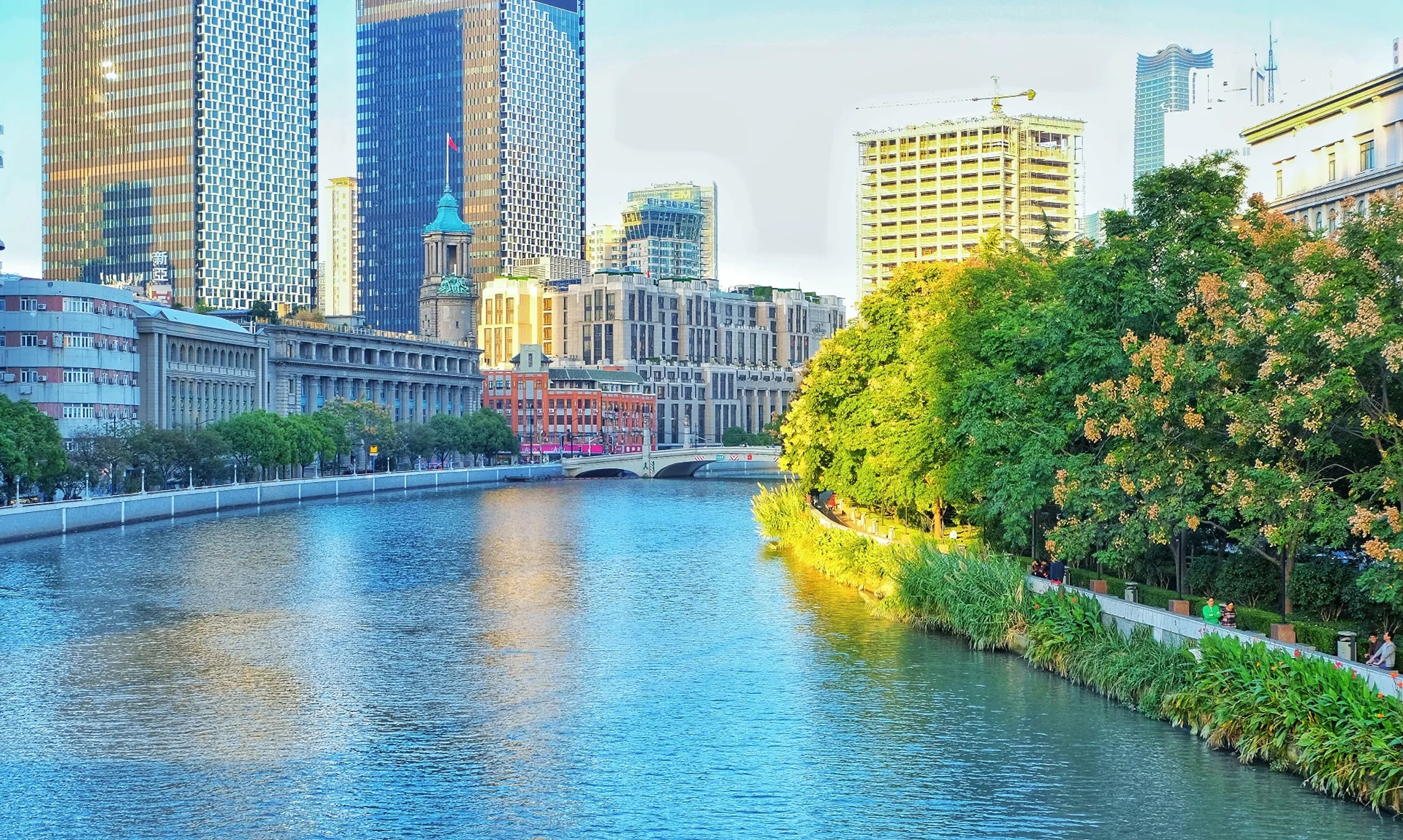
Shanghai isn’t just about the Bund, Xintiandi, or Tianzifang. Beyond the famous spots lies a city full of charm, where streets are lined with plane trees and neighborhoods exude an elegant vibe worth exploring.
Is the Bund Only Zhongshan East 1st Road?
Most visitors stay around the bustling Zhongshan East 1st Road, but once you cross Waibaidu Bridge, the atmosphere shifts—quieter, more reserved. This historic steel truss bridge, over a hundred years old, often appears in classic Chinese films and has become an iconic symbol of Old Shanghai. Nestled between Suzhou Creek and the Huangpu River is the area known as the Bund Origin (Waitanyuan), a charming enclave filled with heritage buildings. Follow the river westward, and you’ll reach the Sihang Warehouse, immortalized in the war film The Eight Hundred.
Read Next: To explore more of Shanghai's historic districts, don't miss our guide to Shanghai's Famous Old Villas or Old Ximen and Yuyuan Garden.
Suzhou Creek: Shanghai’s Historical Lifeline
Writer Wang Anyi once described Suzhou Creek as,
" The boats sail along the river, while the buildings on the banks unfold like a magic lantern show… The warehouses, homes, and blooming rapeseed flowers blend into a watercolor scroll."
This winding river has long been intertwined with Shanghai’s story. Once heavily polluted during the city's industrial boom, Suzhou Creek was dubbed “the blooming black peony.” But after major restoration efforts, it has returned to life, now flanked by leafy promenades, historic architecture, and inviting riverside paths. Notable landmarks include Waibaidu Bridge, the former British Consulate, Shanghai Postal Museum, and the Sihang Warehouse.
Waibaidu Bridge: A Bridge with Stories
Built in 1908, Waibaidu Bridge is Shanghai’s first all-steel riveted bridge. It’s been featured in iconic works like The Bund (TV series), Leaving Me, Loving You , Lust, Caution , and most memorably in Romance in the Rain when the character Yiping jumps into the river. The name “Waibaidu” translates roughly as “Outer Ferry Crossing,” named for being one of the few free crossings over Suzhou Creek in the 19th century.
Bund Origin (Waitanyuan): Where It All Began
At the confluence of the Huangpu River and Suzhou Creek lies Waitanyuan—literally “the source of the Bund.” This area is home to the Bund’s earliest architecture, beginning with the British Consulate in 1848. Over time, it attracted cultural institutions such as the North China Branch of the Royal Asiatic Society. The name reflects not a geographic origin, but the architectural timeline—these buildings predate the rest of the Bund.
Key structures include:
-
Bund 33 Building 1 : The original British Consulate.
-
Bund 33 Building 2 : The former Consul’s residence (built in 1882).
-
Bund 33 Building 3 : The Missionary Apartments.
-
Bund 33 Building 4 : The Moore Memorial Church (Tian’an Church).
Continue walking along Yuanmingyuan Road and you’ll pass beautifully preserved buildings like the Lanxin Building, Jinxie Building, and the Young Women’s Christian Association (YWCA) Building. Across the creek on North Suzhou Road, landmarks like the historic Pujiang Hotel, Shanghai Mansion, the Russian Consulate, and Shanghai Postal Museum await.
Rockbund Art Museum
Known as the “jewel of the Bund Origin,” this art museum was originally the Royal Asiatic Society Building, completed in 1932. Once a hub for exhibitions, lectures, and a public library, it was one of China’s first public museums. Though it closed in 1952, its spirit lives on through captivating exhibitions that link Shanghai’s golden past with today’s contemporary art scene.
Sihang Warehouse: A Symbol of Resistance
Built in 1931 by four major banks (Kincheng, China & South Sea, Continental, and Salt Industry), this warehouse became famous during the 1937 Battle of Shanghai. Over 400 soldiers from China’s 88th Division, known as the “800 Heroes” (a tactical exaggeration to mislead the enemy), defended the building against overwhelming Japanese forces. The 2020 film The Eight Hundred vividly retells this fierce and heroic stand.
“Upper Corner” (Shangzhijiao): Where Shanghai’s Soul Resides
The real soul of Shanghai isn’t just the skyscrapers along the Huangpu or the glitzy shops of Nanjing Road. It lies in the leafy boulevards of the former French and International Settlements—areas collectively known as “Shangzhijiao” or the “Upper Corner.”
When the French Concession expanded in 1914, Western residents built elegant garden villas and stylish apartments along newly paved roads. The result: a district of mixed European and Chinese influence, shaded by French plane trees and supported by modern amenities (gas, phone lines, sewage, trams). This unique blend of East and West flourished even during WWII, when the French Concession remained untouched due to France’s surrender to the Axis powers.
Wukang Road: A Walk Through Time
Walking Highlights
-
Wukang Mansion (Former Normandy Apartments)
-
Former Residence of Soong Ching-ling
-
Huang Xing Residence & Tourist Center
-
Former Italian Consulate Residence
-
Wukang Courtyard
-
Midan Apartments
-
Former Residence of Ba Jin
-
Romeo Balcony
-
Ferguson Apartments
-
Lane 40, Wukang Road
Wukang Mansion
This striking triangular building, completed in 1924, was Shanghai’s first foreign apartment complex. Its classic French Renaissance design—with red brick walls, balconies, and a rounded corner—stands proudly at the intersection of several iconic streets. Originally home to foreign residents, it later welcomed celebrities from China’s film and arts scene, including Zhao Dan and Qin Yi.
Former Residence of Soong Ching-ling
East of Wukang Mansion sits a German-style villa with red tiles and white walls—the former home of Soong Ching-ling (Madame Sun Yat-sen). Shaded by camphor trees, this elegant house hosted national leaders such as Mao Zedong and Zhou Enlai. Inside, you’ll find her original wedding furniture, keepsakes from global dignitaries, and portraits of her with world leaders.
Huang Xing Residence & Midan Apartments
Most villas on Wukang Road are private, but Huang Xing’s former residence now serves as the local tourism info center and Old House Art Center, offering a rare peek inside. Nearby, the Midan Apartments—a five-story Art Deco building completed in 1931—are another architectural gem designed by the British firm Palmer & Turner.