Transparency Note: This post contains affiliate links. If you book a hotel or tour through these links, we may earn a small commission at no extra cost to you. This helps keep our content free and independent.
If you're planning a trip to Beijing and want to visit the Great Wall, you've probably already encountered the same question every traveler faces: Badaling or Mutianyu?
Both are among the most accessible Great Wall sections near Beijing. Both offer cable cars and comparable facilities. But the experience of visiting each is dramatically different—and choosing wrong can mean spending your day wedged between thousands of other tourists instead of standing alone on an ancient stone battlement with nothing but mountain views in every direction.
I've guided visitors to both sections over the years, and the answer I give is always the same: it depends on what you want. This guide breaks down exactly how they differ so you can make the right call for your trip.
Badaling: The Iconic Great Wall Experience
Why it draws millions: Badaling is the most famous section of the Great Wall, and for good reason. It's the most well-preserved, the most accessible, and the most equipped with modern amenities—cable cars, ropeways, and wheelchair-accessible pathways. If you have limited mobility, elderly family members, or young children in tow, Badaling was built with you in mind.
The section features recognizable landmarks like the Good Hero Stone (好汉碑), the Good Hero Slope (好汉坡), and Wangjing Stone (望京石). There's also a Great Wall Museum and an IMAX theater at the base if you want to learn about the wall's history before or after your climb. Badaling typically receives over 10,000 visitors on peak days during Chinese national holidays.
The reality on busy days: During Chinese national holidays and summer weekends, the experience shifts considerably. Queues for the cable car can exceed 90 minutes. The wall itself becomes a slow-moving human current rather than a place of contemplation. I took a group through on a National Day holiday a few years back, and honestly, the photo opportunities were less about capturing the wall's grandeur and more about cropped strangers in the background.
If you visit Badaling, weekday mornings are dramatically better. Arriving when the gates open at 07:30 on a Tuesday will feel like a different wall entirely—quiet, atmospheric, with unobstructed views from the Good Hero Slope all the way down to the valley below.
Getting there: The most convenient option is a high-speed train from Beijing North Station, which takes just 30-35 minutes and deposits you right at the entrance. Alternatively, the S2 suburban railway offers a scenic route through the mountains (about 80 minutes), though the train schedule is less flexible. Bus 877 is the budget option but can sit in traffic for hours during peak periods—worth considering only if you're on a very tight budget and visiting on a weekday. If you'd rather skip the logistics, book a guided Badaling day tour that includes transport—my guests typically find this the least stressful way to visit.
Winter at Badaling: From personal observation, the winter months (November through February) transform Badaling into something unexpectedly beautiful. The wall and surrounding mountains get blanketed in snow, creating that classic "white dragon winding through the mountains" scene. Photo opportunities at North Tower 8 (北八楼) are particularly striking after fresh snowfall. The tradeoff is the cold—temperatures in the Yanqing district where Badaling sits can drop to -15°C in January, and icy patches on stone steps require proper winter boots with grip.
Tickets and facilities:
- Tickets: ¥40 for adults, children under 18 and adults 60+ enter free
- Cable car: ¥100 one-way, ¥140 round-trip (North Tower 7 to North Tower 8) — skip the ticket office queue and book your cable car online
- Facilities: Restaurants, gift shops, Great Wall Museum, IMAX theater
- Best for: First-time visitors with limited time, elderly travelers, families with small children, those who want the "I visited the Great Wall" photo with minimal physical demand
Mutianyu: The Great Wall as It Should Feel
Why it rewards the extra travel time: Mutianyu sits about 25 kilometers further from central Beijing than Badaling, and that extra hour in the car (roughly 1.5 hours from downtown) buys you something priceless—space. The wall here is equally well-preserved but noticeably less crowded, even during what would be peak season at Badaling.
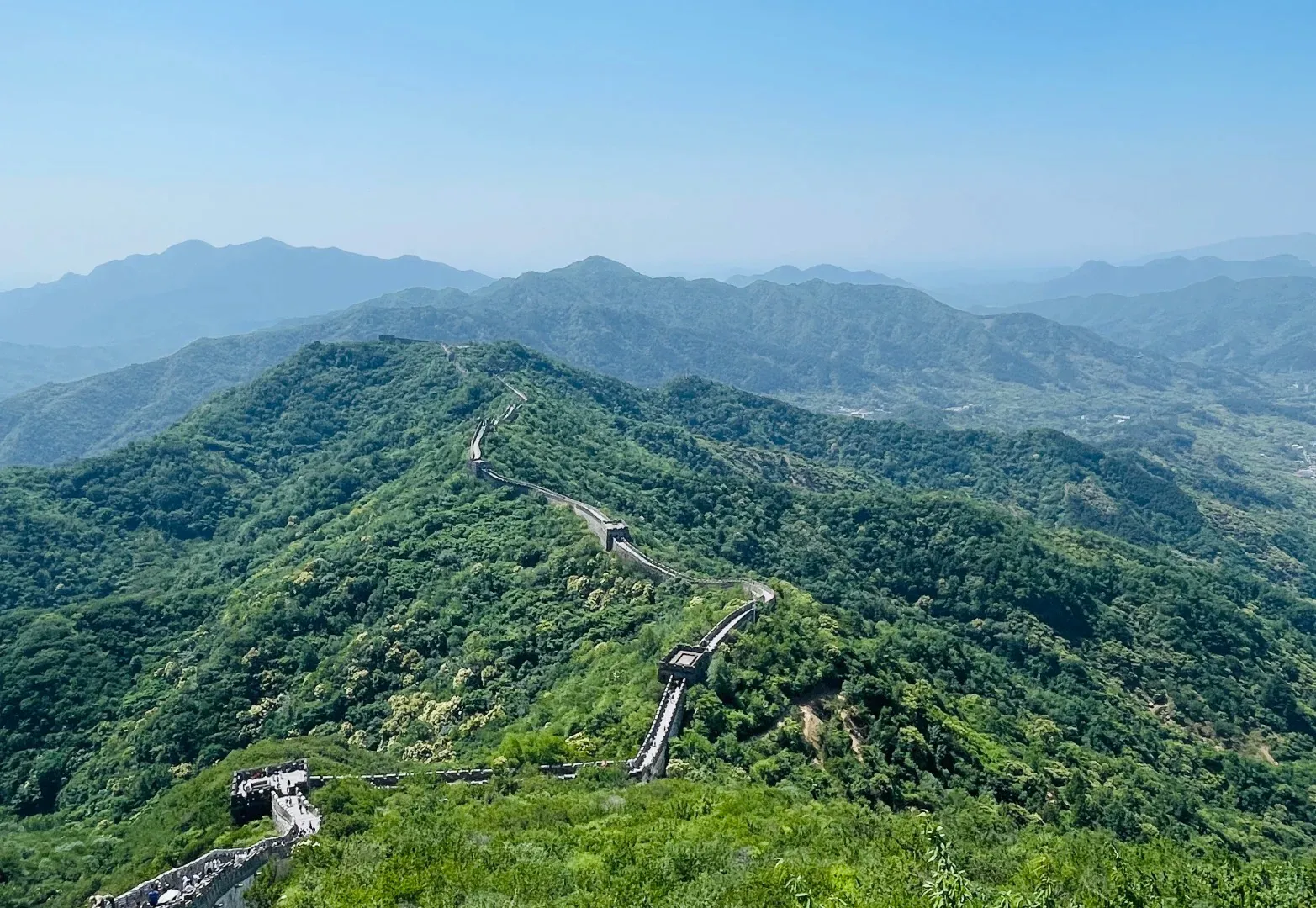
What makes Mutianyu special is the authenticity. The wall here hasn't been quite as extensively restored. You'll see moss on the parapets, wild grass growing between the bricks, and in some stretches, original Ming Dynasty stonework beneath the later repairs. Standing on Mutianyu's ridge and looking both directions along the wall's winding path over the treeline, you can more easily imagine the soldiers who once patrolled here—and the centuries of history compressed into every weathered stone.
The section has distinctive features you won't find at Badaling: the Large Corner Tower (大角楼), the Main Pass (正关台), the Graffiti Wall (涂鸦墙) where visitors have left marks over the decades, and the notoriously challenging "Eagle Flying Backwards" (鹰飞倒仰) section—a steep outer climb that even experienced hikers find demanding.
Getting there: No high-speed rail option at Mutianyu. Most visitors go by chartered car, but if you want the simplest experience with everything arranged, join a full-day Mutianyu bus tour that handles transport, tickets, and often includes lunch. Public transport involves taking Bus 916 from Dongzhimen to Huairou North Street, then transferring to a Mutianyu-bound shuttle. The shuttle frequency is limited, so check departure times in advance.
Winter at Mutianyu: The snow and rime ice scenery here rivals Badaling, but with fewer people in your photos. The vegetation coverage is higher, which means when it snows, you get the striking contrast of white snow against dark pine trees and the grey-green wall—a composition that's particularly popular with photographers. The cable car operates in winter weather (it closes only in severe storms), and riding it through light snowfall over the wall is genuinely magical.
After exploring the wall, nearby farmhouses serve warming winter dishes—柴鸡炖蘑菇 (chicken stew with wild mushrooms) and 羊蝎子 (lamb spine hot pot) are local specialties that hit differently after a cold morning on the wall.
Tickets and experiences:
- Tickets: ¥60 for ticket + shuttle bus combination — secure your Mutianyu tickets and skip the shuttle queue
- Cable car + toboggan: ¥100 one-way (the toboggan down is a highlight for families—essentially a downhill roller coaster through the trees, 5-8 minutes of pure delight for kids and adults alike)
- Best for: Photography enthusiasts, travelers seeking a more authentic atmosphere, able-bodied adults who want to feel the wall rather than just see it, families with older children who can handle the toboggan ride
The Direct Comparison
| Factor | Badaling | Mutianyu |
|---|---|---|
| Crowd levels | Very high, especially weekends/holidays | Significantly lower—roughly 1/3 of Badaling's volume |
| Scenery | Impressive, mountainous terrain, well-maintained | Equally impressive, more vegetation, rime ice in winter |
| Authenticity | Heavily restored, museum-like | Less restored, more original Ming Dynasty fabric |
| Accessibility | Excellent—cable car, elevator, accessible paths | Good—cable car available, but some sections steep |
| Distance from Beijing | ~70km, 1-1.5 hours by public transport | ~90km, 1.5-2 hours by car |
| Facilities | Restaurants, shops, museum, IMAX theater | Basic restaurants, fewer amenities |
| Overall cost | Moderate (¥40 ticket + ¥100-140 cable) | Slightly higher (¥60 + ¥100 cable/toboggan) |
My Honest Recommendation
After guiding hundreds of visitors to both sections, here's my practical take:
Choose Badaling if:
- You have elderly parents or very young children who can't manage steep stairs
- You're visiting only as a quick half-day add-on from Beijing
- You want the classic tourist experience with maximum convenience
- You visit on a weekday (seriously—this changes everything)
Choose Mutianyu if:
- You want to actually feel the wall rather than just photograph it
- You're a photographer or want those empty-wall shots
- Your group consists of active adults or older teenagers
- You're visiting on a weekend or holiday (when Badaling is at its worst)
The tip I give everyone: Time matters more than which section you choose. A Tuesday morning at Badaling beats a Sunday afternoon at Mutianyu. If your schedule allows flexibility, a weekday visit to either section will give you a fundamentally better experience.
For more help planning your Beijing trip, see our Beijing's Must-Visit Highlights or explore the Top Great Wall Sections Near Beijing for alternatives like Juyongguan and Simatai.
Make the Most of Your Beijing Trip
Most Great Wall visitors come from downtown Beijing—and that early morning journey back to the city, exhausted and exhilarated, is often when travelers wish they had a comfortable hotel waiting rather than another hour on public transport. Whether you're arriving late from the Wall or want a convenient base for exploring the city, find the right Beijing hotel for your travel style and budget.