Shanghai cuisine, known as "Benbang Cai" (本帮菜), is an important part of Jiangnan’s regional food culture. It is characterized by a moderate balance of saltiness and freshness, preserving the original flavors of the ingredients, reflecting Shanghai people’s preference for light and refreshing tastes. At the same time, Shanghai offers a wide variety of snacks that carry unique Jiangnan characteristics.
Beyond authentic Benbang dishes, Shanghai—often called "Magic City" (魔都)—is a melting pot of cultures. As one of China’s earliest open port cities, it has welcomed a large influx of international cuisines. Whether you crave Japanese and Korean dishes or want to enjoy Western-style meals, finding them in Shanghai is easy and convenient.
From Breakfast to Late-Night Snacks: A Variety of Shanghai’s Specialty Treats
Shengjian Bao (Pan-Fried Pork Buns)
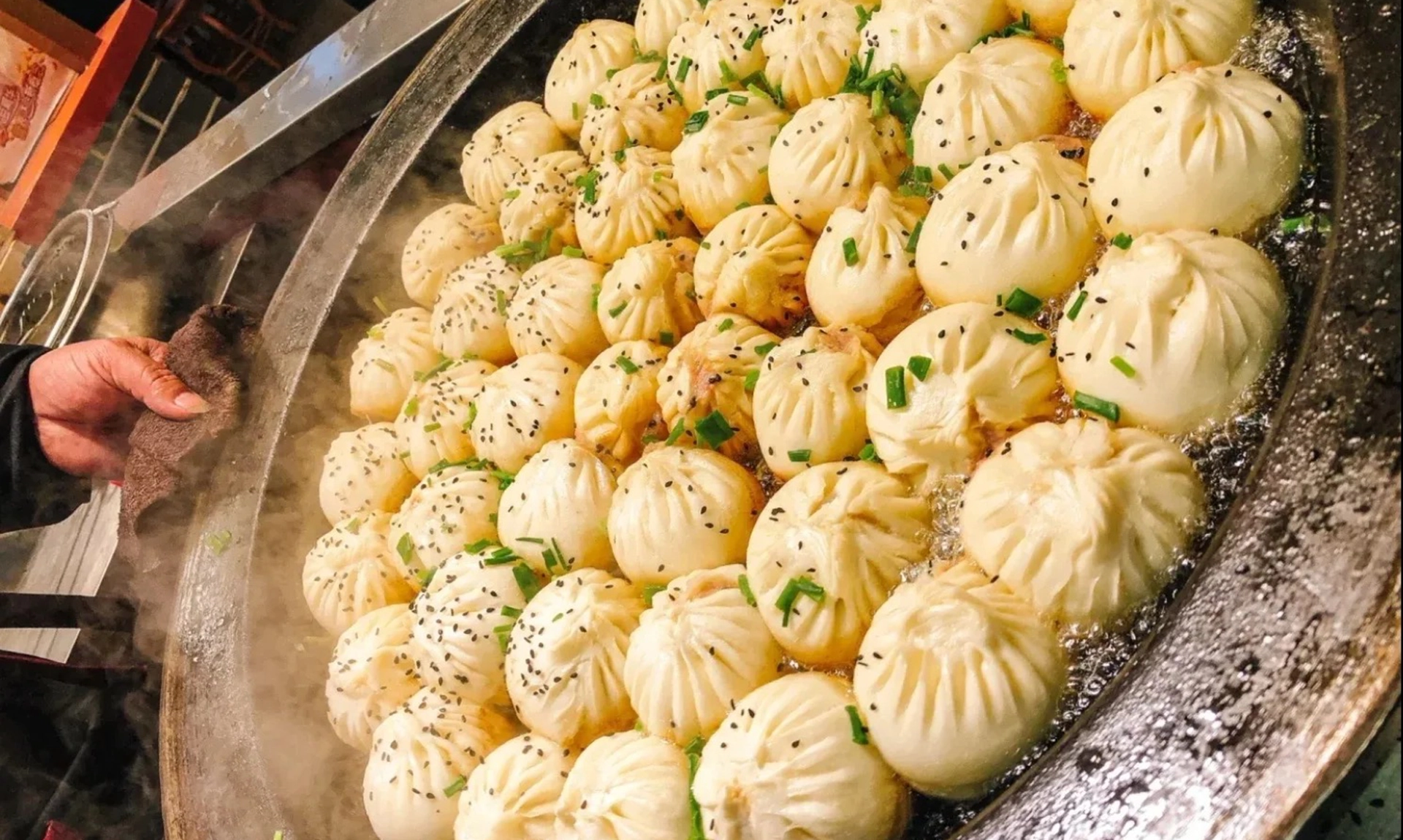
Shengjian Bao is one of Shanghai’s most famous snacks, with a history of nearly a century. The buns have a golden, crispy bottom, topped with sesame seeds and chopped green onions, giving off a delicious aroma. Best enjoyed hot, their skin is crispy while the filling is juicy, bursting with soup inside each bite—making them a local favorite. Traditionally, the filling is pork, but nowadays varieties like shrimp and chicken are also popular.
Note on Shengjian Styles:
There are two main types—“Mixed Water Shengjian” and “Clear Water Shengjian.” The “Mixed Water” style (also called old-style Shengjian) originated in Northern Jiangsu, using semi-fermented dough with fresh pork and aspic, known for thin skin, crispy bottom, juicy filling, and the open side facing down to keep the soup inside. “Clear Water” style, represented by the famous Shanghai old shop Da Hu Chun, uses fully fermented dough, closed on top, with thicker skin and no aspic in the filling, resulting in less soup but a cleaner, less greasy taste.
There are two main types—“Mixed Water Shengjian” and “Clear Water Shengjian.” The “Mixed Water” style (also called old-style Shengjian) originated in Northern Jiangsu, using semi-fermented dough with fresh pork and aspic, known for thin skin, crispy bottom, juicy filling, and the open side facing down to keep the soup inside. “Clear Water” style, represented by the famous Shanghai old shop Da Hu Chun, uses fully fermented dough, closed on top, with thicker skin and no aspic in the filling, resulting in less soup but a cleaner, less greasy taste.
Recommended Places:
-
Xiaoyang Shengjian: Popular chain with many Shanghai branches, affordable and specializing in Shengjian Bao. (~35 CNY) Address: 720 Nanjing East Road, First Food Store, 3rd floor.
-
Youlian Shengjian: Classic shop serving clear water style Shengjian, paired with beef vermicelli soup made with braised beef chunks. (~12 CNY) Address: Huma Road Market.
-
Da Hu Chun: Established in 1932, the oldest traditional Shengjian Bao maker in Shanghai, representing the clear water style. (~28 CNY) Address: 89 Yunnan South Road.
Xiaolong Tangbao (Soup Dumplings)
When it comes to Shanghai’s Xiaolongbao, Nanxiang Xiaolongbao is the most famous. These delicate dumplings are steamed in special small bamboo baskets, hence the name “small basket buns.” Originating from Nanxiang Town, a suburb of Shanghai, they have earned a strong reputation. Many shops around Shanghai serve delicious Xiaolongbao, so you don’t have to visit Nanxiang Old Town to enjoy them.
Nanxiang Xiaolongbao at City God Temple (Chenghuangmiao) has become a must-try for visitors, often attracting long queues for fresh, piping hot dumplings. Besides that, other restaurants like Wanshouzhai, Jiajia Tangbao, and Wangjiasha also serve excellent soup dumplings, so you have plenty of choices.
Recommended Places:
-
Nanxiang Mantou Dian: The most famous old brand, with its main store in the old City God Temple area and many branches. Offers crab roe, fresh pork, and crab roe soup dumplings. Known for thin skin and juicy fillings. (~103 CNY per person)
-
Jiajia Tangbao: Known for traditional broth-filled Xiaolongbao with thin skin and rich flavors, chewy but not greasy. (~15 CNY per basket of 12) Address: 90 Huanghe Road.
-
Wanshouzhai: Uses traditional dough rolling techniques for thin skins, with flavorful fillings, representing authentic Shanghai style Xiaolongbao. (~14 CNY per basket of 16) Address: 123 Shanyin Road.
-
Caicai Xiaolong: A fusion of Suzhou and Taiwanese styles, featuring innovative flavors like crab roe and scallion chicken. Slightly thicker skin but flavorful and visually appealing. (~15 CNY per basket of 8) Address: 504 Tianjin Road.
-
Wangjiasha: A historic brand with a wide variety of flavors including traditional pork and crab roe, well worth the wait. (~50 CNY per person) Multiple branches including Nanjing West Road.
Fresh Meat Mooncakes
Fresh meat mooncakes are a specialty snack from the Jiangsu-Zhejiang-Shanghai region. The crust is crispy and layered, with savory meat filling full of delicious juices. The part where crust and meat meet offers a wonderful taste as the crust soaks up the meat juices.
These mooncakes resemble a mix between Shengjian Bao and Wife Cake, making them less greasy than typical mooncakes. Best eaten hot, their demand peaks around Mid-Autumn Festival, often resulting in long queues at popular shops.
Recommended Places:
-
Zhen Lao Da Fang Snack Shop: Very popular locally, offering fresh meat mooncakes year-round. Multiple stores in Shanghai, with the most popular on Nanjing East Road. (~24 CNY)
-
Guangmingcun Grand Restaurant: Offers dim sum-style snacks on the first floor, including rice rolls, sticky rice cakes, marinated dishes, and fresh meat mooncakes among other traditional Shanghai snacks. (~80 CNY) Address: 588 Huaihai Middle Road, multiple branches.
Pork Rib with Rice Cake
Pork Rib with Rice Cake is an affordable and flavorful snack with over 50 years of history in Shanghai. It’s not a stir-fry but a whole fried pork chop served over two pieces of rice cake. The pork chop is golden and crispy with juicy meat inside. Paired with Shanghai spicy soy sauce and soft, fragrant rice cakes with a slightly sweet and spicy taste, it’s tender and delicious.
Recommended Place:
- Xiandelai Pork Rib Rice Cake: A state-owned old brand, beloved by many locals for its great flavor combined with Shanghai spicy soy sauce. (~28 CNY) Address: 46 Yunnan South Road, with many branches.
Did You Know?
“Spicy soy sauce” (辣酱油) is a special condiment originating from the UK, mixing chili, vinegar, ginger, scallions, sugar, and salt. It’s slightly sour, sweet, umami, and mildly spicy. Only Shanghai and Hong Kong—cities influenced by British culture—use it in cooking. This unique pairing of spicy soy sauce with fried pork chops exemplifies Shanghai’s practical, flexible, and inclusive culinary culture.
“Spicy soy sauce” (辣酱油) is a special condiment originating from the UK, mixing chili, vinegar, ginger, scallions, sugar, and salt. It’s slightly sour, sweet, umami, and mildly spicy. Only Shanghai and Hong Kong—cities influenced by British culture—use it in cooking. This unique pairing of spicy soy sauce with fried pork chops exemplifies Shanghai’s practical, flexible, and inclusive culinary culture.
Shanghai Rice Cakes and Pastries
Shanghai rice cakes are a category of pastries, with Qing Tuan (green rice balls) already famous. Around Qingming Festival, fresh versions are widely available online outside Shanghai. Xinghualou invented a savory version mixing salted egg yolk with pork floss, soft and pleasantly textured, now a trendy snack.
Other local favorites include Tiaotougao (long strip rice cakes) and Shuangniangtuan (double stuffed rice balls). The long strip rice cakes are made from glutinous rice flour with a sprinkling of osmanthus flowers, sweet but not greasy, soft and fragrant. Shuangniangtuan is coated with a thin layer of coconut shreds and filled with rich red bean paste, not oily or cloying.
Many pastry specialty shops and traditional brands have long queues. Some snack shops also sell them.
Recommended Places:
-
Shen Dacheng: Founded in 1875, famous for rice cakes, still popular after 146 years. (~30 CNY) Address: 636 Nanjing East Road, near Chunshenjiang Hotel, with many branches.
-
Xinghualou Restaurant: Established in 1851, a famous Shanghai-style Cantonese restaurant known for Cantonese mooncakes. It owns many Shanghai old brands like Deda Western Restaurant, Wufangzhai, Xiandelai, Xiaojinling, and Da Hu Chun, meaning many local foods are under this company. (~93 CNY) Address: 343 Fuzhou Road, Huangpu District.
-
Shanghai Hongkou Rice Cake Shop: Known for Liang Fanduan (sticky rice ball) that can also be rice cake balls. Loved by locals for breakfast. Filled with stir-fried pickles, dried tofu, and fried dough sticks. Offers sweet and savory options like “Family Feast” with various fillings and crispy fried dough. (~10 CNY) Address: 618 Fuzhou Road, with many branches.
Bonus: Shanghai’s “Four Great Kings” Breakfast
The “Four Great Kings” — savory flatbread, fried dough sticks (youtiao), soy milk, and sticky rice balls — are Shanghai’s classic breakfast.
Many young people now enjoy these as late-night snacks, healthier alternatives to beer and barbecue. The fried dough and soy milk need no introduction; authentic Shanghai flatbread is oven-baked, coming in sweet and savory versions. Sticky rice balls are sweet or savory, filled with bean paste or pickles, often wrapped around a fried dough stick and tightly rolled.
You can find these breakfast staples at any local market stalls or clean chain stores.
Read Next: Hungry yet? For more Shanghai food adventures, check out our Shanghai Walking Guide to find the best streets for snacking while you explore.
Shanghai Cuisine: More Than Just Sweet and Savory Flavors
When it comes to Shanghai cuisine (Benbang Cai, 本帮菜), its rich, dark, and savory flavors—often described as “浓油赤酱” (thick oil and red sauce)—are well known. Signature dishes like Sweet and Sour Spare Ribs (Tangcu Xiaopai, 糖醋小排) and Red-Braised Pork (Hongshao Rou, 红烧肉) are classic examples. But Shanghai cuisine is not just about sweetness and heaviness; it also emphasizes seasonal freshness and light, elegant dishes.
Spring bamboo shoots bring us the famous Salted Pork and Bamboo Shoot Soup (Yanduxian, 腌笃鲜), while before Qingming Festival (early April), Hairtail Fish Noodles (Daoyu Mian, 刀鱼面) become a must-eat. And when the autumn breeze blows, the craving for crabs rises—be it the fat-rich mitten crab, meat crab, or hairy crab. Missing crab season means missing a true Shanghai experience.
Salted Pork and Bamboo Shoot Soup (Yanduxian)
This soup’s name might sound unusual. “Yān” (腌) means salted pork, “dǔ” (笃) refers to slow simmering, and “xiān” (鲜) means fresh meat, usually spare ribs. With simple ingredients like fresh meat, salted pork, and spring bamboo shoots, simmered slowly for hours without extra salt or MSG, the broth becomes incredibly flavorful—fresh enough to “make your eyebrows fall off.”
Sweet and Sour Spare Ribs (Tangcu Xiaopai)
This is a classic Shanghai cold dish known for its balanced sweet and sour taste. Almost every restaurant in Shanghai serves it. Given Shanghai’s preference for sweeter flavors, this dish is a favorite for those with a sweet tooth.
Shanghai Drunken Crab (Zuixie, 醉蟹)
Drunken crab is a unique specialty in Shanghai cuisine, made from fresh river crabs starting in September. The best time to enjoy drunken crab is late November to early December.
Female crabs mature earlier and taste better at the start of the season, but once male crabs mature, drunken male crab is considered superior. The male crab’s roe turns into a delicate, elastic jelly when marinated, offering a special texture and flavor.
Hairtail Fish Noodles (Daoyu Mian)
Hairtail fish (Trichiurus lepturus) is one of the “Three Fresh Treasures of the Yangtze River,” along with pufferfish and shad. It’s the earliest seasonal fish of the year, making hairtail fish noodles a popular dish around Qingming Festival.
One famous century-old restaurant in Shanghai, Lao Banzhai (老半斋), serves what’s technically called “hairtail fish broth noodles” because the dish contains no fish meat—only a rich, milky broth made by simmering hairtail fish. Despite the lack of meat, the soup captures the “number one fresh taste of the Yangtze River” perfectly.
Recommended Restaurants
| Restaurant | Signature Dishes | Avg. Price (CNY) | Address |
|---|---|---|---|
| Lanxin Restaurant (兰心餐厅) | Salted Pork and Bamboo Shoot Soup (spring), Sweet and Sour Spare Ribs | 73 | 130 Jinxian Rd, Luwan District (near Maoming South Rd) |
| Lao Banzhai (老半斋) | Hairtail Fish Broth Noodles (Qingming), Drunken Crab (Nov-Dec) | 50 | 600 Fuzhou Rd |
| Wang Bao He Restaurant (王宝和酒家) | Hairy Crab, Crab Roe Soup Dumplings | 340 | 603 Fuzhou Rd |
“Yangjingbang”-Style Shanghai Western Desserts
Yangjingbang was originally a canal in Shanghai, located between the former International Settlement and French Concession, later filled in to become what is now Yan’an East Road. The term “Yangjingbang English” refers to a quirky form of English that doesn’t follow grammar rules but translates Chinese word-for-word. So you can imagine how “Yangjingbang-style Western cuisine” is just as uniquely interesting.
DeDa Western Restaurant
Established in 1879, DeDa is Shanghai’s oldest “Haipai” (Shanghai-style) Western restaurant and a pioneer of Western dining in old Shanghai. Since 1897, its menu has remained unchanged. The decor is truly vintage, featuring revolving doors, wooden staircases, and intricately carved furniture.
Although it’s a German-style restaurant, its signature dishes like Borscht (Russian soup), Butterfly Pastry (French), and Fried Pork Chop with Spicy Soy Sauce (Shanghai local) reflect a fusion of Russian, French, and Shanghainese flavors — a hallmark of “Yangjingbang-style Western cuisine.”
Address: No. 2 Yunnan South Road (near Yan’an East Road)
Average Price: ¥97
Average Price: ¥97
Harbin Food Factory
Don’t be fooled by the name suggesting smoked sausage or cured meats. The owner previously ran a Western-style pastry business in Harbin, a city known for Russian culinary influences, so they brought Russian-style pastries to Shanghai, blending them with local flavors.
Almond slices and butterfly pastries are longtime favorites among old Shanghainese residents. The almond slices feature a crispy almond and caramel crust; a small bite releases a rich buttery aroma. Butterfly pastries are a must-buy for many elderly locals who take some home whenever they pass by.
Their “Xifanni” cake is particularly beloved by Shanghai parents, as its name sounds similar to “I like you” in Shanghainese. Each delicate layer is a sweet little confession.
Address: No. 603 Huaihai Middle Road, with multiple branches
Average Price: ¥45
Average Price: ¥45
Ruby
The “Creamy Square Cake” is a longtime online sensation in Shanghai’s dessert scene. Simple in appearance, with snow-white fresh cream topped with a few cherries, the soft, pale-yellow sponge cake evokes childhood memories for many Shanghai locals.
Address: No. 198-1 Wujiang Road, Jing’an Four Seasons Garden, with multiple branches
Average Price: ¥30
Average Price: ¥30
Lao Dachang
Though the name doesn’t sound fancy, Lao Dachang is considered a symbol of refined taste among Shanghai’s older generations.
Decades ago in Republican-era Shanghai, near St. John’s University and opposite Zhaofeng Park, this Russian bakery operated. Renowned writer Eileen Chang occasionally picked up some cross-shaped bread after class. The semi-spherical bread has a slightly crispy crust on top, with a half-inch-wide cross base, filled with mildly salty cheese — a subtly delicious combination.
Lao Dachang’s most famous dessert is the “Ice Cake,” reportedly a favorite of Eileen Chang as well. It’s somewhere between ice cream and sherbet, with a silky jade-like appearance and bits of caramelized nuts inside. It melts smoothly in your mouth with a unique texture hard to describe without tasting it. The ice cake is handmade by master chefs using fresh cream and caramelized nuts — a luxury back in the day. Their whipped cream is also highly recommended.
Address: No. 558 Huaihai Middle Road, with multiple branches
Average Price: ¥30
Average Price: ¥30
Kaisiling
Many young Shanghainese first hear about Kaisiling from their parents. Once a symbol of taste and romance among old Shanghai gourmets, Kaisiling is famous for its chestnut cake and “Haddou.”
“Haddou” features a chocolate crispy shell on the outside, a crunchy pastry layer in the middle, and creamy filling inside — a triple-layer delight in every bite. The chestnut cake is generously filled with real chestnut paste and covered with thick fresh cream — small but rich in flavor.
Address: 3rd Floor, No. 1001 Nanjing West Road, with multiple branches
Average Price: ¥40
Average Price: ¥40
Shanghai: The True “Coffee Capital”
Strolling down the shaded paths and tree-lined streets, you’ll find the air filled with the rich aroma of coffee. Beyond its famous cuisine, coffee has become another iconic symbol of Shanghai. Today, with over 8,000 cafés, Shanghai surpasses cities like Paris, London, New York, and Tokyo in the number of coffee shops, earning its well-deserved title as the “Coffee Capital of the World.”
These cozy coffee spots have naturally become an essential part of daily life for locals. In this innovative, forward-thinking, and inclusive city, homegrown specialty coffee brands like M Stand , Seesaw , and Manner have emerged, while a variety of coffee shops offer endless creative possibilities in ambiance and style.
Whether you’re a longtime Shanghainese, a newcomer, or a foreign visitor, you can always find a café in Shanghai that feels just right—a place to soak in the city’s unique culture and warmth.
Yi Coffee
Highlight: Located near the historic site of the First National Congress of the Communist Party, housed in traditional Shikumen architecture. Each cup tells a story of history.
Address: No. 373 Huangpi South Road, Huangpu District
Average Price: ¥30
Opening Hours: 09:00–17:30
Address: No. 373 Huangpi South Road, Huangpu District
Average Price: ¥30
Opening Hours: 09:00–17:30
Hu Coffee
Highlight: Owned by a champion barista who won the coffee Olympics.
Address: No. 1, Building 7, Hongqiao Zhengrong Center, Lane 666, Shenhong Road, Minhang District
Average Price: ¥34
Opening Hours: 08:00–16:00
Address: No. 1, Building 7, Hongqiao Zhengrong Center, Lane 666, Shenhong Road, Minhang District
Average Price: ¥34
Opening Hours: 08:00–16:00
sômthin’else
Highlight: A dopamine-themed café designed to boost your mood.
Address: No. 1208 Yuyuan Road, Changning District
Average Price: ¥74
Opening Hours: Monday 10:00–20:00; Tuesday to Sunday 10:00–22:30
Address: No. 1208 Yuyuan Road, Changning District
Average Price: ¥74
Opening Hours: Monday 10:00–20:00; Tuesday to Sunday 10:00–22:30
Boardroom
Highlight: Ski-themed café with a second-floor ski board history museum.
Address: No. 457 Jumen Road, Room 103, Huangpu District
Average Price: ¥31
Opening Hours: Monday to Friday 08:30–20:00; Saturday to Sunday 09:30–20:00
Address: No. 457 Jumen Road, Room 103, Huangpu District
Average Price: ¥31
Opening Hours: Monday to Friday 08:30–20:00; Saturday to Sunday 09:30–20:00
Shanghai’s Famous Food Streets
If you want to enjoy a variety of delicious foods all in one place, be sure to check out some of Shanghai’s popular food streets.
Lujiazui Food Street
Located in Shanghai’s prime business district, this food street inside a shopping mall features architecture inspired by Huizhou style and the Republican era. You’ll find authentic and affordable snacks here.
How to get there: Lujiazui Metro Station, Super Brand Mall, 6th Floor
How to get there: Lujiazui Metro Station, Super Brand Mall, 6th Floor
Yunnan South Road
Though less than 300 meters long, this street is packed with various restaurants. If you want to try classic Shanghai home-style dishes, this is the spot. Favorites include pork ribs with sticky rice cake, Dashu Spring Shengjian buns, and old duck vermicelli soup.
How to get there: Line 8, Dashijie Station
How to get there: Line 8, Dashijie Station
Old Shanghai Style Street, Lane 1192
A vintage food street on Century Avenue where you can leisurely enjoy a wide range of local delicacies.
How to get there: Century Avenue Metro Station, Exit 8, take the escalator on the right
How to get there: Century Avenue Metro Station, Exit 8, take the escalator on the right
Huaihai Road
Known as the “Haagen-Dazs” for Shanghainese, this street offers a mix of specialty snacks and Western-style cuisine, including Guangmingcun pork mooncakes, Lao Dachang ice cream, curry shops, and more.
How to get there: Line 1, Shaanxi South Road Station
How to get there: Line 1, Shaanxi South Road Station
Even just local snacks and time-honored brands would take you more than a week or two to fully explore. Not to mention, Shanghai’s food culture, inherited from the Republican era until today, remains stylish and diverse. Beyond local cuisine, the global food scene in Shanghai is also vibrant and thriving.
Due to space limits, there’s so much more delicious Shanghai food waiting for you to discover in person—time to go taste it yourself!