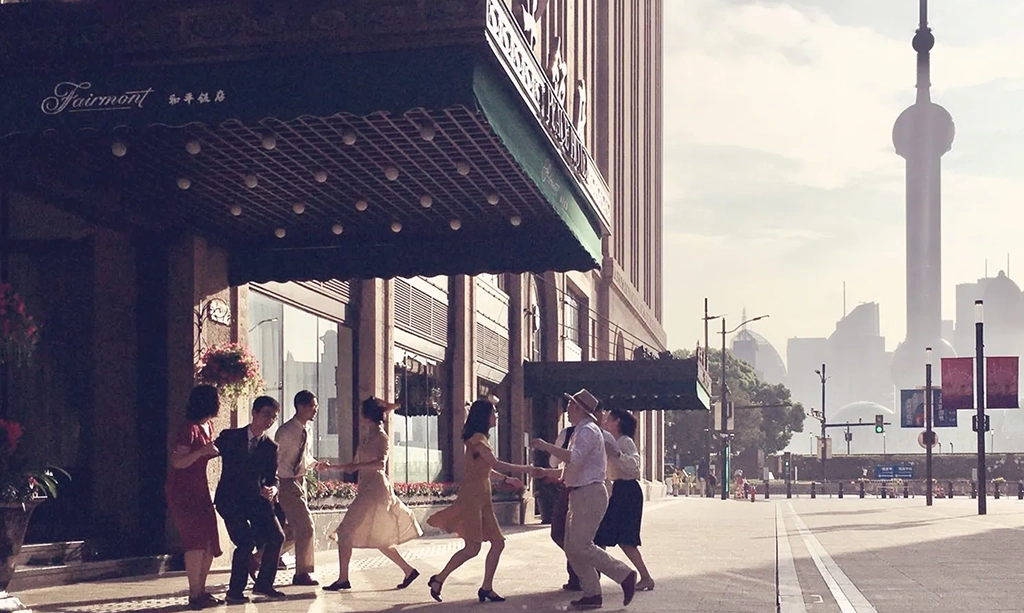
What to Explore on Nanjing Road? The Legendary "Ten-Mile Foreign District" Starts Here
"A fleeting dream of the ten-mile district, a century of charm that lives on"—this poetic couplet engraved in the former foreign concession stirs the imagination of Shanghai’s golden age, a time of neon lights and Western opulence. What many don’t realize is that this legendary “Ten-Mile Foreign District” stretches from the Bund in the east to Jing’an Temple in the west, cutting across Huangpu and Jing’an districts. And it’s none other than the iconic Nanjing Road.
The Rise of Nanjing Road: From Colonial Beginnings to Modern Glamour
Nanjing Road’s origins date back over 150 years. It began when early Western settlers in Shanghai funded the construction of the city’s first horse racing track near today’s East Nanjing Road. For easier access, a small road— Huayuan Nong (花园弄)—was later built to connect the area to the Bund. This soon evolved into a bustling marketplace.
To aid the Qing army in resisting the Taiping Rebellion, the government extended Huayuan Nong westward to Jing’an Temple using an approach known as “boundary-crossing road building,” giving rise to what is now West Nanjing Road. As colonial influence grew, foreign businesses flooded the street, introducing Western goods and a cosmopolitan flair. The introduction of a tram system in 1908 further boosted its development, solidifying Nanjing Road’s status as the “Number One Commercial Street in the Far East.”
Nanjing Road Today: From Historic Charm to High-End Luxury
While the “Ten-Mile Foreign District” era has long passed, East Nanjing Road (南京东路, Nánjīng Dōng Lù) remains a bustling pedestrian street dubbed “China’s No.1 Commercial Street.” It's lined with time-honored local brands and department stores and is a must-visit for any traveler to Shanghai.
Meanwhile, West Nanjing Road (南京西路, Nánjīng Xī Lù) has transformed into one of Shanghai’s most upscale shopping areas, home to flagship stores of luxury brands and boasting the city’s highest retail rents. Together, they represent the fascinating fusion of history and modern consumer culture that defines Nanjing Road.
Read Next: Ready to explore more of Shanghai’s historic streets? Check out our Explore Shanghai’s Western-Style Streets guide to dive deeper into the city’s unique Haipai culture.
Nanjing East Road: A Shopper’s Paradise Steeped in History
Long before mega malls and international chains took over, Nanjing East Road (南京东路, Nánjīng Dōng Lù) was already a commercial powerhouse. As early as the 19th century, the “Big Four” department stores—Sincere, Wing On, Sun Sun, and The Sun—set up shop here. Interestingly, all four were founded by overseas Chinese from Zhongshan, Guangdong who had settled in Australia. Their entrepreneurial success was once seen as a model of “national salvation through industry”—even Sun Yat-sen was reportedly a shareholder.
By the early 20th century, Nanjing East Road had become a major draw for millions of tourists annually, and it remains home to many laozihao (老字号, long-established and reputable local brands) that continue to thrive today.
Sincere Department Store (先施百货)
The earliest of the Big Four, Sincere’s original location is now home to the Shanghai Fashion Store. Designed by the German-Taiwanese firm Tso-Toh & Co., its façade features open arcades and a distinctive corner tower supported by Tuscan columns. When it opened in 1917, the store boasted a rooftop garden and even an indoor amusement park.
Sincere pioneered many retail innovations: it introduced fixed pricing (no bargaining), a weekend staff rotation system, and was the first to employ female staff in a department store—revolutionary ideas at the time.
📍 Address: 660 Nanjing East Road, Huangpu District
Wing On Department Store (永安百货)
Fans of Chinese spy dramas may recognize the name Wing On. Located across from Sincere, this six-story building was designed by Palmer & Turner and blends Ionic columns with Baroque-style towers—an eclectic mix of Western styles.
Wing On published one of China’s earliest shopping magazines (Wing On Monthly) and hosted live celebrity performances, soon surpassing Sincere in popularity. Later, the founder’s son expanded the business by purchasing a neighboring teahouse and commissioning a tower from renowned firm Atkinson & Dallas. This "New Wing On Tower" was connected to the main store via a skybridge and now operates as the Seventh Heaven Hotel.
📍 Wing On Store: 635 Nanjing East Road
📍 Seventh Heaven Hotel: 627 Nanjing East Road
📍 Seventh Heaven Hotel: 627 Nanjing East Road
Sun Sun Department Store (新新百货)
The third of the Big Four, Sun Sun was designed by renowned Hungarian architect László Hudec (also responsible for the Grand Cinema and Cathay Theatre). The six-story building is topped with two pointed towers and now houses the Shanghai First Foodhall.
Unlike its predecessors, Sun Sun was the first department store officially registered in mainland China. It focused on high-end local brands and earned a patriotic reputation among Shanghai residents.
📍 Address: 720 Nanjing East Road, Huangpu District
The Sun Department Store (大新百货)
The youngest of the four, The Sun opened in 1936 but quickly became a leader. Its ten-story reinforced concrete building featured not only retail space on the lower levels but also ballrooms, restaurants, indoor amusement parks, and rooftop gardens.
It introduced China’s first underground shopping level and first department store escalator. The Sun took a more affordable, mass-market approach and ultimately became the most successful of the Big Four. It was later renamed Shanghai No.1 Department Store and remained the largest department store in China until 1980.
📍 Address: 830 Nanjing East Road, Huangpu District
Time-Honored Local Brands: A Taste of Old Shanghai
Beyond the Big Four, Nanjing East Road’s pedestrian street is lined with famous laozihao shops—offering a delightful trip back in time.
-
Shen Dacheng (沈大成) : A century-old pastry shop, known for its salted egg yolk and pork floss green rice balls—so popular in spring that people queue for hours.
-
Lao Da Fang (老大房) : Famous since the Daoguang era (19th century) for its savory pork mooncakes.
-
Shanghai First Foodhall (上海第一食品商店) : Great for local snacks like butterfly pastries and seaweed crisps.
-
Shao Wansheng (邵万生) : Specializes in marinated and fermented foods; their ni luo (泥螺, pickled mud snails) are a delicacy.
-
Zhang Xiaoquan (张小泉) : A legendary scissor shop founded in 1628.
-
Duoyunxuan (朵云轩) : A haven for traditional Chinese stationery and calligraphy tools.
These shops aren’t just places to buy souvenirs—they’re where generations of Shanghainese formed some of their fondest childhood memories.
Nanjing West Road: A Glimpse into Colonial-Era Elegance
Compared to the bustling, department-store-filled Nanjing East Road, Nanjing West Road offers a more refined and luxurious experience. Flanked by elegant apartment buildings, time-honored Western restaurants, cozy cafés, and classic cinemas, this area exudes a nostalgic charm that’s perfect for a leisurely cultural stroll.
Changde Apartment: Where Zhang Ailing Once Lived
Built in 1936 by the architectural firm Léonard & Veysseyre (Lai On & Co.), Changde Apartment is shaped like a shallow “U,” featuring curved lines typical of the Art Deco style. Each floor housed three apartments, each over 150 square meters, making it a residence for Shanghai’s upper-middle class during the Republican era.
Famed Chinese writer Zhang Ailing (Eileen Chang) once lived here. During her time in the apartment, she frequently visited local cafés and cinemas along Nanjing West Road—experiences that later inspired scenes in her novels.
Address: No. 195 Changde Road, Jing’an District
Kaisiling Café: A Wartime Legend with German Flavor
Fans of Chinese spy dramas might recall the line “Let’s meet at Kaisiling on Avenue Joffre.” That very Kaisiling Café still stands today on Nanjing West Road. Founded in 1928, the café got its name as a token of gratitude toward a warlord who helped the owner secure the prized real estate—shops on this street were hot commodities even back then.
The café features authentic German-style décor and serves light meals and pastries. Zhang Ailing was a regular here, and the café even makes an appearance in her famous novella Lust, Caution as one of the heroine’s haunts.
Today, Kaisiling continues to operate from its original location. The first floor sells takeaway pastries, while the third floor offers a cozy café experience. Don’t miss the café’s famous chestnut cake and Swiss roll —a bite of old Shanghai in every forkful.
Address: No. 405 Guangqi South Road, Huangpu District
Opening Hours: 7:00 AM – 9:00 PM
Average Cost: ¥32/person
Opening Hours: 7:00 AM – 9:00 PM
Average Cost: ¥32/person
Deda Western Restaurant: Shanghai’s Oldest Western Eatery
Established in 1897, Deda Western Restaurant —originally known as Deda Hotel—is Shanghai’s oldest surviving Western restaurant. Spread across two floors, the lower level serves desserts and small bites, while the upper floor offers full Western meals. The elegant wooden staircase, grand chandeliers, dark blue walls, and mosaic tile flooring all whisper of old-world European charm.
Specializing in German-influenced dishes adapted to Chinese tastes, Deda has become a favorite among locals and nostalgic “Old Shanghainese.” Its signature Deda sirloin steak , along with borscht, pork cutlets, and garlic bread , are perennial crowd-pleasers.
Address: No. 473 Nanjing West Road, Huangpu District
Opening Hours: 11:00 AM – 1:30 PM; 5:00 PM – 8:00 PM
Average Cost: ¥115/person
Opening Hours: 11:00 AM – 1:30 PM; 5:00 PM – 8:00 PM
Average Cost: ¥115/person
Travel Tip: Walking or Biking the Nanjing Road
Nanjing Road is the longest commercial street in Shanghai , stretching from east to west. The East Nanjing Road is about 1,599 meters long and is ideal for walking, though it's often crowded—keep an eye on your belongings.
In contrast, the West Nanjing Road spans 2,933 meters and is lined with picturesque buildings and quieter streets, making it perfect for exploring by bicycle.