What Are the Must-See Buildings in Shanghai?
Step into the World of Architect László Hudec
When it comes to iconic architecture in Shanghai, anyone who's lived in this city has likely heard of László Hudec (邬达克, Wū Dákè). Born into a family of architects in Slovakia (then part of Hungary), Hudec endured years of war and displacement before eventually settling in Shanghai, where he spent over two decades. During his time here, he left behind more than 100 buildings, many of which still define the city’s skyline today. From the renowned Wukang Mansion to the Grand Cinema and the Park Hotel, his creations are woven into the very fabric of Shanghai’s urban identity.
This guide introduces six of Hudec’s most representative architectural works in Shanghai—each one a fascinating piece of history—and includes practical tips for visiting these iconic sites.
Read Next: Interested in more of Shanghai's historic architecture? Explore our Shanghai Walking Guide to discover the city's most iconic lanes and Bund-area heritage buildings.
Meifeng Building: Hudec’s Humble First Project
In 1915, a 25-year-old Hudec arrived in Shanghai as a refugee. Hoping to earn enough for a ticket back home, he began working at the architectural firm of R.A. Curry. His very first project in the city was the Meifeng Building on Ningbo Road.
Built in 1920, this modest four-story building sits on a street corner and is easy to overlook. It features no ornate Baroque details or grand Ionic columns. Instead, it reflects a straightforward functionalist design, focused more on purpose than beauty. Today, the building blends seamlessly into the surrounding community—its ground-level shops and neighboring alleyways bustling with daily life.
Though unassuming, this small building marks the beginning of Hudec’s architectural legacy in Shanghai, a quiet start to what would become a transformative era for the city's built environment.
Address: Intersection of Henan Middle Road and Ningbo Road, Huangpu District, Shanghai
Wukang Mansion: An Iconic Landmark in Shanghai’s French Concession
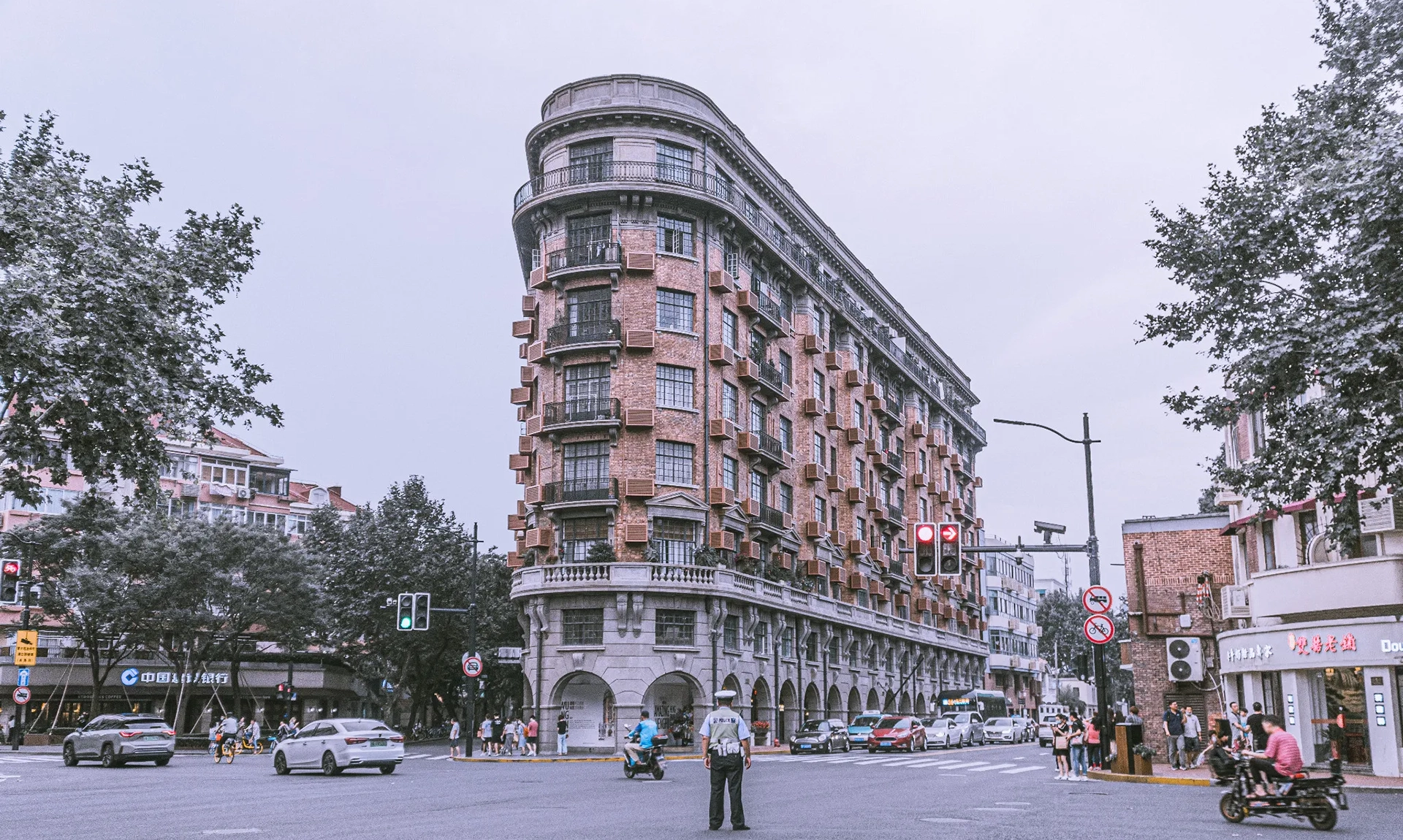
If there’s one Hudec building that nearly every visitor to Shanghai recognizes, it’s Wukang Mansion (武康大楼, Wǔkāng Dàlóu). Originally named the Normandy Apartments, this building was completed in 1924 and remains a masterpiece of French Renaissance architecture in Shanghai. Shaped like an iron wedge, it stands dramatically at the intersection of five roads, making it one of the most photogenic buildings in the city.
Its signature red-brick exterior, rounded balconies, and deep overhanging eaves make it instantly recognizable. The building has long attracted photographers, filmmakers, and architecture enthusiasts, and its romantic silhouette has been featured in countless movies and TV shows.
In its heyday, Wukang Mansion housed a number of Shanghai’s elite, including movie stars like Ruan Lingyu and Zhao Dan. Though it was later divided into smaller apartments, many original architectural details—such as the elegant staircases, mosaic flooring, and vintage mailboxes—can still be found inside.
The building’s sharp prow and European façade create a sense of timelessness. Today, Wukang Mansion is not only a beloved historic site but also a living residential building, blending past and present in one of Shanghai’s most atmospheric neighborhoods.
Address: 1836–1858 Huaihai Middle Road, Xuhui District, Shanghai
Park Hotel: Once Asia’s Tallest Skyscraper
Before the age of Pudong’s towering skyline, Park Hotel (国际饭店, Guójì Fàndiàn) was the pride of Shanghai. Completed in 1934, this striking Art Deco skyscraper stood at 83.8 meters tall, making it the tallest building in Asia until 1952—and the tallest in Shanghai until the 1980s.
Designed by László Hudec, the building was modeled after the American Radiator Building in New York. Its dark brown granite façade, vertical lines, and geometric detailing are hallmarks of the Art Deco movement. Located on the edge of People’s Square, the hotel became a symbol of modernity in Republican-era China.
Park Hotel was more than just an architectural marvel—it was a cultural hub. It hosted celebrities, diplomats, and business magnates from around the world. Its famous revolving rooftop restaurant offered panoramic views of the city, and its ballroom witnessed countless grand parties and historical moments.
Today, while taller and flashier buildings have taken over Shanghai’s skyline, Park Hotel remains a cherished heritage landmark. Step inside and you’ll still find original design features like vintage elevators, marble columns, and intricate lighting fixtures—preserving the elegance of a bygone era.
Address: 170 Nanjing West Road, Huangpu District, Shanghai
Grand Cinema: Shanghai’s Silver Screen Legend
Opened in 1933, the Grand Cinema (大光明电影院, Dà Guāngmíng Diànyǐngyuàn) is one of Shanghai’s most historic movie theaters. Designed by Hungarian architect László Hudec, who also created Park Hotel, the building is a striking example of streamlined Art Deco architecture.
In its heyday, the Grand Cinema was the most luxurious theater in the Far East. It premiered many classic Chinese films during Shanghai’s golden age of cinema and was a gathering place for artists, celebrities, and cinephiles. Inside, the theater featured cutting-edge acoustics, plush seating, and elegant ornamentation, offering a truly glamorous moviegoing experience.
Though it has undergone several renovations, the cinema retains much of its original style and charm. Today, it continues to operate as a popular venue for both Chinese and international films, blending nostalgia with modern cinematic technology.
Address: 216 Nanjing West Road, Huangpu District, Shanghai
The Green House: Hudec’s Final Legend in Shanghai
The last building László Hudec left behind in Shanghai is known as the “Green House” (绿房子, Lǜ Fángzi), a distinctive private villa on Tongren Road. Its nickname comes from the exterior walls, which are entirely covered in green mosaic tiles.
The four-story villa features large south-facing terraces on every level, offering expansive, deck-like views reminiscent of a cruise ship. The entire building embraces curved design elements—arched stairways, rounded ceilings, and even a wooden elevator shaped like a lotus leaf. In fact, it was the first private residence in Shanghai equipped with an elevator.
The Green House has changed hands several times over the years, but people still remember its first owner best—Wu Tongwen (吴同文), a paint magnate who made his fortune producing military green pigment. Green became his lucky color, and he commissioned Hudec to design this one-of-a-kind, ultra-luxurious home. Wu loved it so much that when oil tycoon Sir Victor Sassoon offered him a 10,000-ton oil tanker and $500,000 to buy the house as a consulate, Wu refused, famously declaring, “Even in death, I want to die in the Green House.”
Today, the villa serves as the office of the Shanghai Urban Planning and Design Research Institute. It is not open to public tours.
Address: 333 Tongren Road, Jing’an District, Shanghai (near Beijing West Road)
Hudec’s Former Residence: A Personal Legacy
To gain deeper insight into the life of this legendary architect so closely tied to Shanghai, be sure to visit Hudec’s former residence on Panyu Road. This English-style country villa, which Hudec designed and built for himself in 1931, features exposed timber framing and a steeply pitched roof in classic Tudor style.
Hudec lived here with his family for six years, often hosting garden parties. He also kept pigeons on the rooftop, feeding them daily. In 1947, at the age of 54, Hudec left Shanghai with his wife—taking with him the wooden front door and his drafting table from No. 129 Panyu Road.
The ground floor now serves as the Hudec Memorial Hall. With its teak wall paneling and mosaic tile flooring, the space has been preserved much as it was during Hudec’s time. Visitors can view original blueprints and photos of his work. The second floor is currently not open to the public.
Address: 127–129 Panyu Road, Changning District, Shanghai
Opening Hours: Tuesday to Friday, 2:00–4:00 PM; Saturday & Sunday, 9:00 AM–4:00 PM; closed on Mondays
Admission: Free
Opening Hours: Tuesday to Friday, 2:00–4:00 PM; Saturday & Sunday, 9:00 AM–4:00 PM; closed on Mondays
Admission: Free
A Century On, Hudec’s Legacy Lives in Stone
A hundred years have passed, but Hudec’s architectural masterpieces continue to shape Shanghai’s skyline and inspire awe. As world-renowned architect I.M. Pei once said, “Hudec’s buildings were, are, and will always be a brilliant part of Shanghai’s cityscape.”