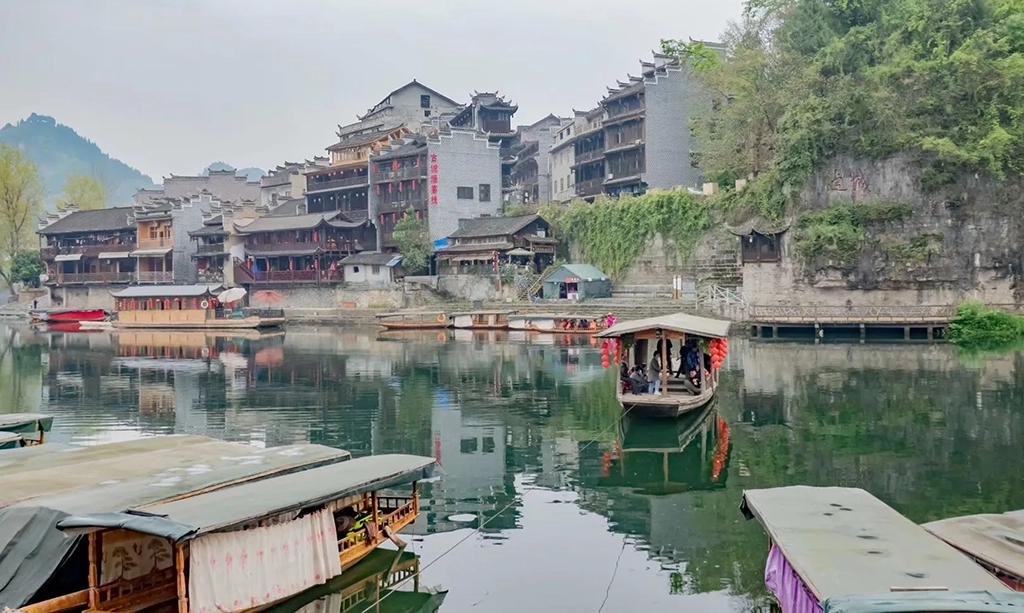
Hidden Ancient Towns in Western Hunan: Quiet Alternatives to Zhangjiajie and Fenghuang
Zhangjiajie and Fenghuang Ancient Town are undoubtedly the most famous destinations in western Hunan (Xiangxi), but their popularity often means crowds and noise. What many travelers don’t realize is that Xiangxi is also home to lesser-known riverside villages and timeworn trading posts, where ancient customs live on and nature thrives undisturbed. If you're hoping to experience the culture of western Hunan without the tourist hustle, consider exploring these hidden gems. This guide introduces several off-the-beaten-path ancient towns that offer a more peaceful and authentic adventure.
Read Next: Planning your Western Hunan adventure? Our Zhangjiajie Travel Guide covers Tianmen Mountain and the Grand Canyon, and Xiangxi Local Food has the best eats in the Zhangjiajie-Fenghuang region.
Dehang & Aizhai: Miao Villages, Valleys, and Sky-High Bridges
Just 4 kilometers apart, Dehang (德夯, Déhāng) and Aizhai (矮寨, Āizhài) can easily be visited together in one trip. Centered around the Miao village of Dehang, the area is surrounded by three prominent peaks—Pangu Peak, Peacock Spreading Tail Peak, and Four-Horse Peak—and three scenic valleys. Two of the streams, Longquan Creek and Hangxia Creek, are out-and-back hikes, while Yuquan Creek connects to the main road, making it easier to exit.
Dehang Village, nestled in a deep green valley, retains its traditional stone-paved paths. Be sure to cross the historic Jielong Bridge, originally built during the Republic of China era—it’s impressively high and photogenic. You can also climb Pangu Peak, though the trail can be slippery and is not recommended during rain. Hangxia Creek remains untouched and undeveloped, perfect for exploration during the spring and summer high-water seasons. Don’t miss Liusha Waterfall on Jiulong Creek, which boasts the biggest waterfall drop in China.
Getting Around
The best way to explore the Dehang–Aizhai route is by hiring a local driver—it’s affordable and flexible.
Tickets
-
Dehang Scenic Area: ¥100
-
Aizhai Suspension Bridge: ¥168
- Pro tip : Want to see the Aizhai Bridge for free? Drive along the winding Aizhai mountain road and stop at the first big curve—this spot offers a stunning panoramic view of the bridge. You can also see the bridge clearly from anywhere in Aizhai Town below. The best view is from Wángyé Shānzhài (王爷山寨) near the final curve heading into town. Though food there is pricey, the bridge view is unbeatable.
Furong Town: A Waterfall Town Suspended in Time
Furong Town (芙蓉镇, Fúróng Zhèn), formerly known as Wangcun (王村), gained fame as the filming location of the Chinese movie Hibiscus Town , starring Jiang Wen and Liu Xiaoqing. Today, it's known as the "Thousand-Year-Old Town Hanging on a Waterfall" thanks to the spectacular waterfall that cascades through the old street at the southern entrance. Layer upon layer of wooden stilt houses (吊脚楼, diàojiǎolóu) cling to the cliffs, resembling stacked rice cakes—an iconic scene you won't find elsewhere in Xiangxi.
The best photo spot is the waterfall viewing platform below Yinan Square (翼南广场). From here, you can capture both tiers of the waterfall with the ancient village in one frame.
Be sure to try mǐ dòufu (米豆腐), a soft rice tofu snack made popular in the film. While Liu Xiaoqing’s “official” rice tofu shop is at No. 113 Old Street, in truth, nearly every stall serves a similar version for around ¥5.
Wandering through Furong Town feels like stepping into a storybook—its narrow stone alleys curve through lush mountains and follow the riverside. The five-mile stone-paved street, ancient wooden houses perched above the water, and the thunderous waterfall echoing through the hills all add to the charm and mystery.
Red Stone Forest Geopark
Nearby, the Red Stone Forest National Geopark (红石林国家地质公园) is home to China’s only red karst landscape. The vivid red rocks are carved with horizontal grooves created by ancient seawater erosion. Fascinatingly, most of the grooves appear at the same height, indicating the sea level from 480 million years ago.
Tickets
-
Furong Town: ¥110
- Note : Staying in a guesthouse inside the old town waives the entrance fee.
-
Red Stone Forest Geopark: ¥148
Transportation
Furong Town Bus Station has frequent departures to and from Jishou, Yongshun, and Guzhang—about one bus per hour.
There’s also a direct bus between Furong Town and the Red Stone Forest (around ¥10, hourly). A round-trip by private car costs approximately ¥150.
There’s also a direct bus between Furong Town and the Red Stone Forest (around ¥10, hourly). A round-trip by private car costs approximately ¥150.
Chadong (Border Town): Step into Shen Congwen’s World
Chadong (茶峒, Chádòng) is a tranquil riverside town in Huayuan County, made famous by the beloved Chinese novel Border Town (《边城》) by Shen Congwen. The heroine, Cuicui, lived in this serene village surrounded by misty hills, white pagodas, and the gentle current of the You River. Just as the book describes, Chadong has it all—an old ferry crossing (拉拉渡, lālā dù), wooden stilt houses named after the legendary boatman Shunshun, and a pace of life that seems untouched by time.
Smaller and quieter than nearby Phoenix Ancient Town (Fenghuang), Chadong offers an authentic glimpse into everyday Miao culture and the rhythm of river life.
One of the most unique things to do here is take a ride on the lālā ferry for just ¥2. In less than a minute, you’ll cross from Hunan Province into Hong 'an Town (洪安镇) in Chongqing. There you’ll find a stone monument marking the point where Hunan, Chongqing, and Guizhou all meet—a perfect photo op at the junction of three provinces.
Transportation
There are no direct buses from Jishou or Fenghuang to Chadong. The most convenient way is to transfer at Huayuan. From Huayuan Bus Station, buses to Chadong depart roughly every 15 minutes and cost around ¥7.
While it may not be on most travelers’ radars, Chadong’s quiet alleys, ferry crossings, and local rhythm make it a place where literature and life gently blur together. Compared to the tourist-packed streets of Fenghuang, here you’ll feel the pulse of real Xiangxi living—where a two-yuan ferry ride becomes a poetic journey.
Liye: A Hidden Gem with 2,000 Years of History
Liye (里耶, Lǐyè) may look like just another sleepy riverside town, but don’t be fooled—this place made headlines when over 36,000 bamboo slips from the Qin Dynasty (221–206 BC) were unearthed here, turning it overnight from a quiet border town into one of China's most significant archaeological sites.
The name “Liye” comes from the Tujia language, meaning “the beginning of heaven and earth.” In ancient times, it was a bustling commercial hub known as “Little Nanjing.” Today, it retains much of its unpolished charm—think moss-covered stone alleys, traditional blue-gray wooden homes, and courtyards built for merchants in the old days.
You can explore the Liye Qin Bamboo Slips Museum for free and marvel at the ancient script etched onto slender bamboo strips. Surprisingly, some characters are still easy to recognize today, making the connection across millennia feel startlingly personal.
Where to Stay
Choose a guesthouse near the Ancient City Ruins Park —many offer direct views of the site. Some inns even allow free entry to the park (regular ticket: ¥60), so you can wake up to a scene straight from the history books.
Transportation
Liye is located along the scenic You River. The bus station is on Changsha Street , with regular buses connecting to Jishou , Longshan , and Yongshun.
Don’t Miss:
Stroll along the riverfront streets where you’ll find a mix of Xiangxi-style wooden buildings and Anhui-style residences with white-washed walls and black-tile “horse head” roofs. Framed by forested hills, the town exudes an old-soul beauty that feels timeless.
Yuanling: Where Rivers Meet and Legends Begin
Yuanling (沅陵, Yuánlíng) sits where the You River and Yuan River converge—a historically vital water gateway once known as Chenzhou (辰州). In the days before roads carved through the mountains of Western Hunan, this riverside town was the main artery for people and goods traveling in and out of Xiangxi. It's even mentioned in tales about the mysterious "corpse walking" rituals said to have originated here.
The town is home to the Yuanling County Museum , where you’ll find Longxing Lecture Temple (龙兴讲寺, Lóngxīng Jiǎngsì) —one of the oldest Buddhist academies in the world , founded during the Tang Dynasty (7th century). Remarkably, it’s been preserved using traditional mortise-and-tenon joinery , with no nails or glue. Thanks to continuous repairs through the Song and Qing Dynasties, the temple showcases a unique blend of historical Chinese architectural styles.
Quiet Temples and Mountain Views
A short distance away is Phoenix Mountain (凤凰山, Fènghuáng Shān) —a serene Buddhist retreat nestled in the forest. It’s not widely known, which means you’re more likely to hear chanting monks than tourist chatter.
Getting There
Despite being connected to Phoenix Ancient Town by river, land travel is a bit less direct. The easiest way is to transfer in Jishou or Huaihua. Or, if you’re feeling adventurous, try a section of the historic river route :
Yuanling → Xiaoxi → Furong Town —a journey that echoes the routes once taken by merchants and returning villagers centuries ago.
Yuanling → Xiaoxi → Furong Town —a journey that echoes the routes once taken by merchants and returning villagers centuries ago.
Yuanling may lack the crowds of better-known destinations, but for those craving solitude, scenery, and stories carved into ancient temples and riverbanks—it’s exactly the kind of place that stays with you long after you leave.